
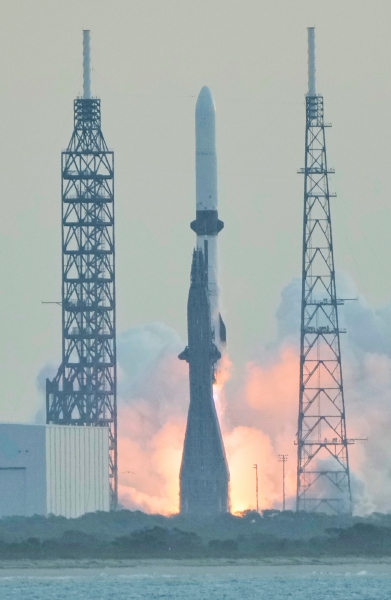
WASHINGTON (EFE).— The space company Blue Origin, of Amazon founder Jeff Bezos, managed for the first time to reuse one of the propellants of its New Glenn rockets, a milestone reached in the third launch of this system, key for the company in its competition with SpaceX, of Elon Musk.
The New Glenn took off the day before yesterday from the Cape Canaveral Space Force Station (Florida) with a reused propellant, which after the separation of the two stages of the rocket was recovered in the Atlantic Ocean, approximately 10 minutes after launch.
The takeoff was scheduled at the beginning of a two-hour launch window, but Blue Origin stopped the countdown three minutes and 57 seconds before it due to an issue that has not yet been revealed but was later fixed.
This launch system was the same one that Blue Origin used on the second mission of the powerful 98-meter rocket last November, when it managed to land the booster on a platform in the sea after a failed attempt in early 2025.
Until then, only SpaceX, founded by billionaire Musk, had successfully demonstrated this type of reuse in orbital flights with its Falcon 9 rockets, and even with its enormous Starship.
The second stage of the rocket launched the day before yesterday continued its trajectory into space to fulfill its main mission of placing the AST SpaceMobile communications satellite into orbit.
This third mission, called NG-3, is “momentous” for Blue Origin, highlighted Jordan Charles, vice president of the New Glenn program, during the launch broadcast. “Without a doubt, we are extremely proud of our reconditioning team for having managed to prepare this rocket for a new flight in the record time in which they did so,” he added.
The reuse of New Glenn is crucial to the economic viability of Bezos’ company, which aims to use it on NASA’s Escapade mission to Mars, aimed at studying the interaction between the solar wind and the planet’s magnetic field, which will provide scientists with essential information about how it lost its atmosphere.
SpaceX’s ability to reuse the propellants of its Falcon 9 is one of the main reasons why Musk’s company has managed to dominate the global orbital launch market for the moment.
Blue Origin is currently finalizing preparations for its first robotic lunar lander, with a view to launches in the coming years.