
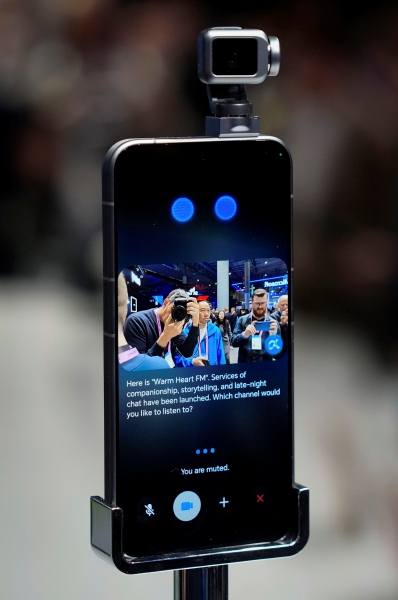
BARCELONA (EFE).— Cell phones were losing space over the years in a congress initially organized in their honor, but now they are rearing their heads again: cameras with robotic arms, devices with three screens and an increasingly present AI mark the edition of the Mobile World Congress (MWC) 2026 in Barcelona.
The organizing association, GSMA, estimates that almost half of the more than 100,000 expected attendees and the 2,900 exhibitors no longer have anything to do with the telecommunications sector, but the cell phone news, especially promoted by Asian brands, continues to attract attention when one walks through the fair, which has been held in the Catalan capital for 20 years.
It is not yet on sale, but it is already one of the sensations of the event: a phone from which a small robotic arm equipped with an AI camera suddenly emerges. It is the Robot Phone, from the Chinese firm Honor.
This has several advantages: greater image stabilization – this robotic arm is responsible for this and not the user’s pulse; rotation capacity to pursue the target, without having to move the phone, and ease of defining frames that would require a certain contortionism for a person.
Pop-up phones have become popular, which can double the size of their screen either to read a document more easily or to watch a movie. Honor and Motorola are betting on them.
Now Samsung wants to push harder with its Galaxy Z TriFold model, which has not two but three screens and grows large until it practically reaches the size of a tablet. It went on sale in South Korea and the United States and is now available in Spain.
Until recently, having AI elements on the phone was an extra luck, but now it is a structural part of the device: it is not just another application, but part of the system. It is the so-called Agentic AI. New Samsung models, for example, incorporate Google’s Gemini 3, while Xiaomi integrates DeepSeek technology.
Examples of what the future may hold: Broken dishwasher? The cell phone and its AI, with the ability to navigate between your applications, will be able to directly purchase—and not just recommend the steps to follow—the replacement part from a simple photo.
You’ve probably tried your luck at some point to try to figure out what video the subway user next to you is watching. Samsung has also realized this and has come up with a solution to combat intrusive glances: the Flex Magic Pixel system.
The phone’s screen combines wide emission pixels, that is, visible from any point, and narrow emission pixels, only distinguishable from a frontal position. The trick is to turn off the wide emission when appropriate to scare away onlookers.
On April 28 of last year, the widespread blackout suffered by the Iberian Peninsula left most of the population cut off from communication, a setback that can be resolved through satellite connectivity.
It is the bet of Starlink, Elon Musk’s satellite communications company, which is testing its system in Barcelona during this MWC. Linked to this, the company explains that its service allowed some 400,000 people not to lose communication during the devastating Los Angeles fires last year.
Digital avatars
A Spanish start-up, with the collaboration of clubs such as FC Barcelona, Liverpool and Paris Saint-Germain, has developed digital avatars based on genetic data and biomarkers with the aim of improving injury prevention in elite football.
The Catalan company specialized in precision health Made of Genes has presented, within the framework of the Mobile World Congress, its Digital Twins project, which uses artificial intelligence to convert biomedical data, GPS records and wearable devices into a “digital twin” of the player.
According to the co-founder and CEO of the firm, Laura Isús, this tool allows the coaching staff to “integrate genetic information, health indicators and workloads into a single model,” in order to “anticipate the risk of injury, personalize nutrition and adjust training and competition planning.”
The system also incorporates biomarkers from omics technologies, such as genomics, proteomics or metabolomics, common in the hospital setting, to transfer advances typical of precision medicine to elite sports.
The algorithms used are differentiated by sex, given that “the pattern of injuries varies between men and women,” Isús states, and their validation is carried out with data from active professional soccer players.
The project, which has been in development for years, seeks to convert large volumes of data (genetic, epigenetic, biomedical, GPS and wearable devices) into actionable information through explainable artificial intelligence.
According to the doctor, this allows “personalizing nutritional plans, dynamically preventing injuries and simulating different scenarios” to support the decision-making of the coaching staff, always with clean and well-structured data to guarantee that the algorithms “are reliable.”
Liverpool’s first team physical trainer, Jack Ade, and Paris Saint-Germain’s head of innovation, Ben Simpson, participated in the round table, who agreed that the key to innovation in clubs is “integrating data from different sources” and “achieving the acceptance of players and coaches” so that the new tools are effective.
For his part, the head of FC Barcelona’s medical area, Dr. Gil Rodas, has pointed out that the Catalan club has been searching for “more than 15 years” for biomarkers that make it possible to anticipate injuries and improve training planning, progressively incorporating advanced technologies used in hospitals.
Experts have also highlighted the ability of “digital twins” to simulate different scenarios, such as training load or availability for matches, allowing preventive decisions to be made and reducing the risk of injuries in professional football.
Those responsible for the project have pointed out that these digital models allow a “more proactive” approach to sports science, moving from the reaction to injuries to prediction and prevention, integrating physiology, biomechanics and genetics in a single system.
Likewise, Ade has highlighted that the technology facilitates “real-time monitoring of players”, combining data from portable devices, video analysis and motion captures, which allows the internal and external load of each footballer to be evaluated in a personalized way.
Isús has added that the integration of differential data by sex is “key”, since recent studies show that men and women present different patterns of response to training and risk of injury, so the algorithms adapt to these differences to improve the precision of the predictions.
The project also contemplates collaboration between clubs and technical departments to share knowledge and good practices, “even with Real Madrid,” Rodas joked, with the aim of creating robust and reliable tools that can be applied transversally in different teams and competitions.
Xiaomi Hypercar
Xiaomi exposes the electric hypercar prototype created for the “Gran Turismo” saga.
Aerodynamic
This futuristic, gray, aerodynamic-looking vehicle features a teardrop-shaped driver’s cabin and one with a halo-shaped rear light. The Vision GT will not be for sale.
Deportiva
But the company showed the SU7 Ultra, the sports version of a car that it will market.
Cars for sale
Xiaomi aims to sell more than half a million cars this year and has electric models such as the YU7 and SU7.
Related
You may also like
-
Why does the iPod excite young people?
-
Paramount and HBO Max merge: A new streaming giant is born to compete with Netflix
-
Bad Bunny triumphs on Spotify after Super Bowl: Listening increases more than 85% in Spain!
-
Apple launches iPhone 17e and iPad Air M4
-
How sophisticated is the camera on the Samsung Galaxy S26 Ultra?