
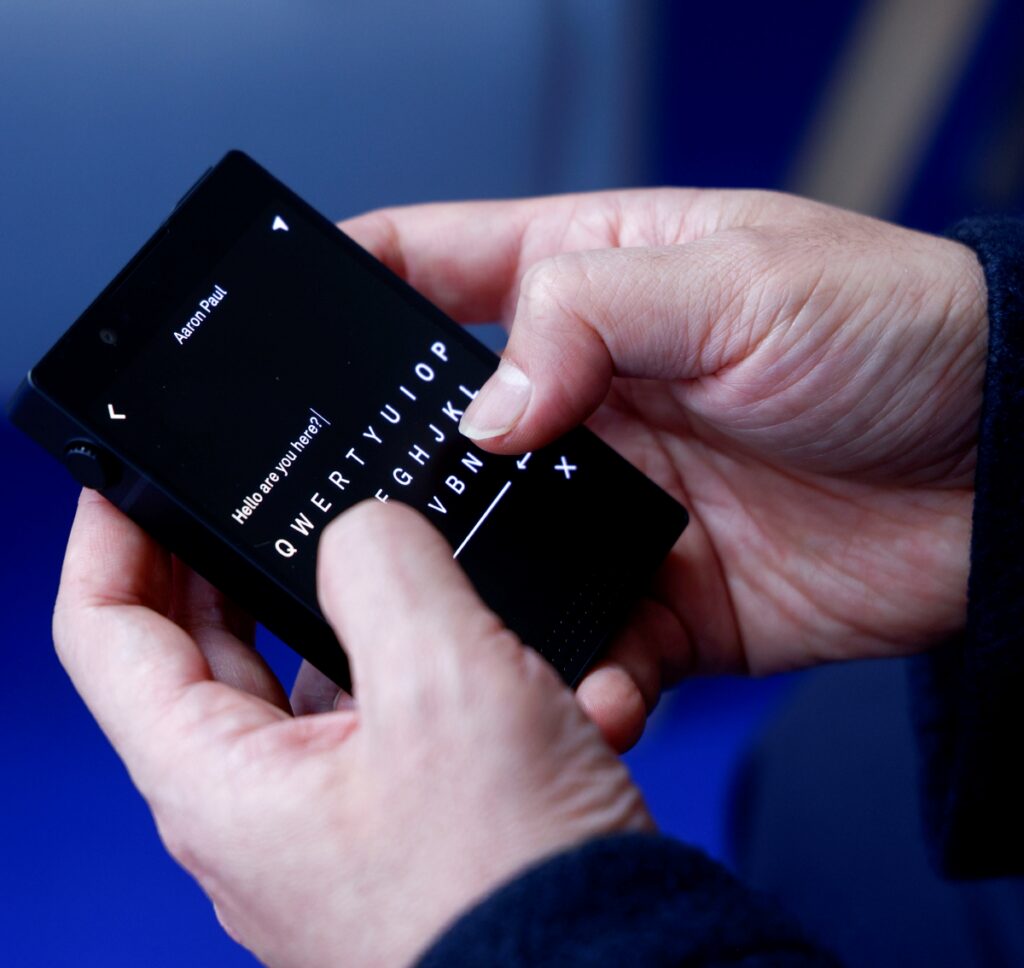
BARCELONA (EFE).— Increasingly smart cell phones coexist at the Mobile World Congress (MWC) with their perfect antithesis: the so-called “dumb phones,” minimalist devices designed to reduce addiction to screens and improve digital well-being, especially among the youngest.
One of the great paradoxes this year at the MWC, the global epicenter during this week of innovation and connectivity, is the space it has given to voices that call for rationalizing the time of use of technology and promote “disconnection”, a trend that is gaining strength in the sector.
Among those voices, the actor Aaron Paul, from the series “Breaking Bad”, who has become an activist in favor of a more balanced use of cell phones and other devices, stood out. “We are not going to be able to stop the development of these technologies, but we can create new, less addictive ways of designing and producing phones,” he said.
The company Light, one of the first companies to bet on this new generation of minimalist cell phones, has also gained prominence.
Its proposal is radical in its simplicity: black phones, without artifice or frills, with a basic screen and functional applications that allow you to call, take notes and consult directions. No social media icons, constant notifications or stimuli designed to retain the user’s attention.
“It is not about giving up the cell phone, but about offering another perspective, an alternative. Devices like Light Phones are like a camera: just another technological tool, which you use when you need it, but which does not capture your life,” said Light’s general director, Kaiwei Tang, in a speech at the congress.
The aesthetic minimalism of these devices may remind us of the past, of those famous Nokias of the late 90s, although the promoters of Light maintain that their phones are not the past, but rather “they represent the future of technological development.”
“It may seem like you are taking a step back, but in reality you are moving towards something more human. It is returning to our origins, yes, but moving forward: leaving the artificial behind to stay with intelligence and the more human side of technology,” explains a partner of the company, Eleph Kwong.
If the Light Phones represent the antithesis of the so-called smartphones, halfway there are the Balance Phones, a proposal promoted in Barcelona and that aspires to integrate the best of both worlds.
“There is too big a space between what is a basic cell phone and what is a smartphone. We want to place ourselves right in the middle and create a device with which you do not have to give up anything in your daily life, but at the same time does not keep you exposed to all that addictive content that steals our time,” explains the co-founder and creator of the Balance Phone, Carlos Fontclara.
For this reason, its commitment is to maintain those applications that really provide added value to the user, such as WhatsApp for instant conversations or Spotify for listening to music, without encouraging dynamics that engage the screen for hours.
In fact, the Balance Phone is designed to structurally block applications that account for more than 70% of recreational use time, such as social networks, but maintains between 80% and 90% of the “essential” functionalities for daily use.
Fontclara explains that the original idea was to promote this type of device among the youngest. However, they soon discovered that families were the most interested. “Half of our sales are fathers and mothers looking to buy their children’s first cell phone,” he details.
Light’s operations manager, David Wheeler, on the other hand, assures that the majority of his clients are between 20 and 40 years old, mainly millennials.
The humanoids
Humanoid robots capable of carrying out both industrial and social tasks are proliferating this year at the MWC, where they have aroused great curiosity among attendees. In practically every pavilion of the technology fair, considered the most important in the sector, there are androids with human appearance and attitude, from some that dance to the rhythm of viral video clips to others designed for the hospitality industry, and all are the subject of videos and photographs from the public.
In fact, the technology director of Mobile World Capital Barcelona, Eduard Martín, notes the proliferation of these robots, the “great novelty” of 2026, which are added to the traditional automatons without human form and those that are attached to the person to provide new functionalities, like a cyborg.
At the fair facilities of the Shanghai-based company AgiBot, a dancing humanoid robot called
At his side, his older brother, A2, answers the questions posed to him thanks to the artificial intelligence (AI) system he incorporates and, behind him, a robot dressed as a waiter demonstrates his skills at serving glasses of cava.
These androids, which aim to reach homes little by little, share space in Congress with a robotic dog designed for emergency situations and a cleaning device that does not require human interaction.
Elsewhere, China Mobile exhibits a fast food restaurant run by Lingxi robots: while two prepare the food in the kitchen, a clerk is in charge of bringing the customer the food they have ordered at the counter.
The Spanish company PAL presents TIAGo Pro, a humanoid that delights visitors for its ability to learn human movements and replicate them.
The company highlights that this ability is especially useful in industry – the robot is already present in textile companies – and in research; also in the social and health sector, to which it is fully adapted because it has a sufficiently narrow base that allows it to move in corridors or adapted homes.
Near this humanoid is ARI, another robot with a digital face that Barcelona City Council has implemented in 500 homes in the city where users of social and health telecare live.
Although it does not replace professionals, the android developed by the Saltó group makes it possible to detect – among other situations – falls or domestic incidents in homes for the elderly.
The technology director of Mobile World Capital Barcelona emphasizes that “what is interesting” about innovations in robotics is, on the one hand, the arrival of androids in areas beyond industry and, on the other, their complementation with the human body, which will give rise to “hybrid personalities.”
“Before they were called cyborgs, which would be humans that incorporate technological components, such as an exoskeleton or chips in their skin,” explains Martín, who foresees this new variant in a few years.
Martín recognizes that there is “a certain dilemma” around humanoid robots because, by looking like people, “they cause an identity crisis” among the population in case they can replace human labor.
“Many times we do not realize that there are robots without human appearance that already replace what we do,” warns Martín next to a robotic arm developed by the Institute of Advanced Architecture of the Spanish region of Catalonia in collaboration with the company Ceràmica Cumella that replicates the movement of the artisan to glaze a piece of ceramic.
They complement each other
Complementing human workers with the specific skills of robots is more productive than replacing them, according to Kate Darling, a researcher at the Massachusetts Institute of Technology (MIT), one of the international references in the study of interaction with these machines.
“People have the ability to deal with unexpected events. Even in warehouses and factories, with very structured environments, if a nail falls on the floor you need a human,” Darling said at the Talent Arena, a simultaneous event at MWC.
Darling, author of the book “The New Breed,” warned that one of the current problems in the debate about robotics and artificial intelligence is that they are constantly compared to human intelligence, when it would be more useful to think of them in terms similar to animal abilities.
“It’s boring to try to recreate something we already have. We can create something that supports human capabilities or that allows us to do things that we couldn’t do before,” said the expert, who for fourteen years has studied the relationship with robots and AI.
In his opinion, in the same way that throughout history human beings have relied on the abilities of animals to enhance, and not replace, their own abilities, technology can now play that role.
In the workplace, he recalled that attempts to replace workers often encounter practical limits. Machines perform especially well at structured, repetitive tasks, while humans excel at adapting to the unexpected.
“If we combine those capabilities creatively, we can scale production much more powerfully than if we simply try to replace people,” he emphasized.
In his opinion, the tendency to anthropomorphize technology responds to biological conditioning: humans are programmed to recognize faces and signs of life, and autonomous movement is a powerful trigger for that perception. “Even something as simple as a robot vacuum cleaner, because it moves on its own, makes people give it a name,” said the researcher, who admits that she herself named hers “Bobby.”
In his opinion, this inclination will not disappear and some systems will be perceived as tools, while others will be seen as companions.
Regarding future regulations regarding robotics, he anticipates that “we will probably want to protect what we feel emotionally close to.”
The researcher stressed that much of the public debate continues to be conditioned by the idea that the objective of artificial intelligence is to reproduce human intelligence, an aspiration that, according to her, was at the origin of the discipline and still guides many developers.
However, that comparison is limited. Machines vastly outperform humans in certain tasks, such as mathematical calculation, chess and detecting patterns in large volumes of data, but they make mistakes that would be obvious to a person due to a lack of context, he warned.
Prohibition Social networks
The creator of the WWW defends prohibiting social networks for those under 16 years of age
Addictive algorithms
The inventor of the World Wide Web, Tim Berners-Lee, warned during a conference of the “addictive algorithms” of some social networks, such as TikTok
Different interface
For this reason, Berners-Lee asked social media developers “not to design them like TikTok,” but rather like less addictive platforms, like Pinterest.
There is no opposition
“I was in Australia and it was interesting talking to the kids… They weren’t opposed at all. I think some of them found that having a world where they could actually play with their friends and without phones was quite rewarding,” Berners-Lee said
Implemented in Spain
The president, Pedro Sánchez, announced that Spain will prohibit access to social networks for minors under 16 years of age and will adopt other measures to increase control of digital platforms
Related
You may also like
-
‘Pokémon Pokopia’ changes battles for the well-being of its creatures
-
Apple launches the new MacBook with M5 chip: What is their price and what new features do they bring?
-
Unmissable offer at Fnac: Buy a Nothing (3) and get a Lite (3a) FREE!
-
The end of scams: Ticketmaster launches new dynamic digital ticket against fraud
-
Apple is renewed – Diario de Yucatán