
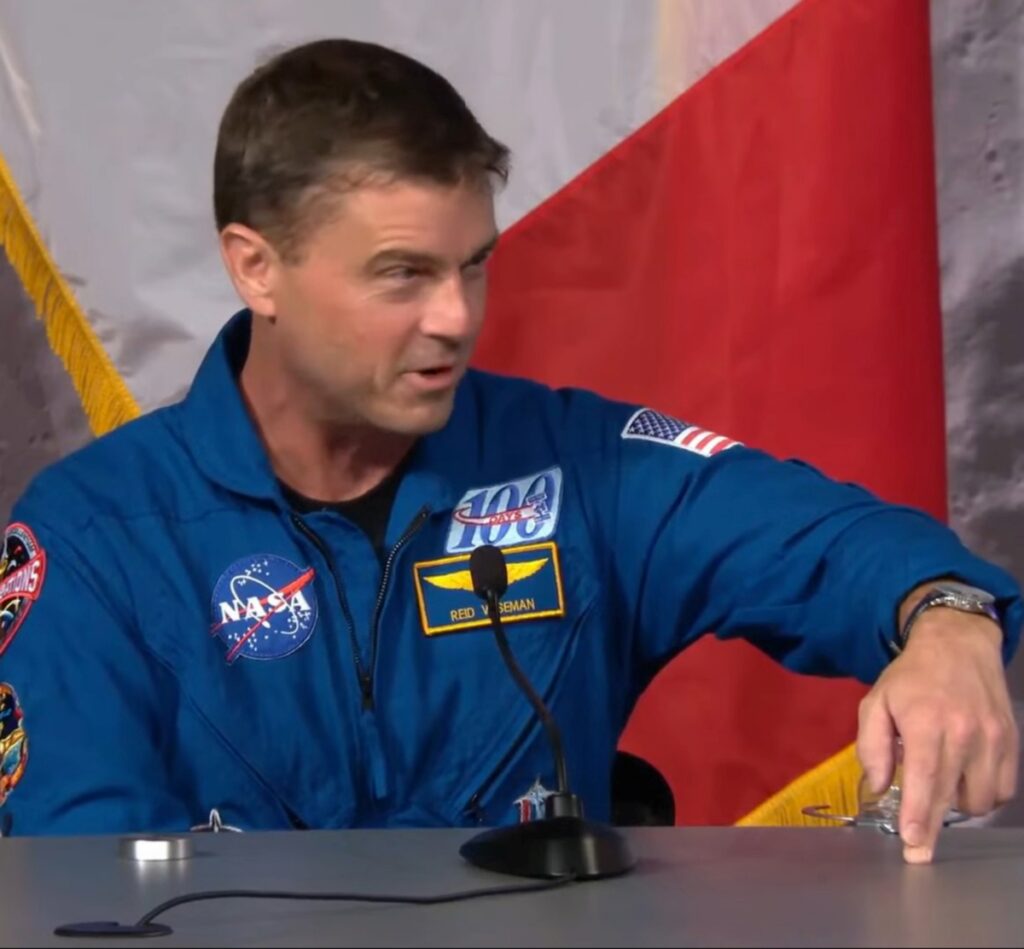
MIAMI (EFE).— The commander of the Artemis II mission, Reid Wiseman, stated that the toilet they used on the space expedition “was wonderful” despite the reported problems, which, he said, were related to the ventilation system.
“I just want to say 100% upfront: It was a wonderful toilet. The toilet worked great. Where we had a problem — and it was a real problem, for sure — was in our primary vent line,” Wiseman said in a news conference from the NASA facility in Houston.
“The toilet flushed perfectly, but when the liquid came out of the bottom, it got stuck in our ventilation line,” added the commander of the four-crew mission, which returned to Earth last Friday after orbiting the Moon.
The toilet in the Orion capsule where the astronauts were traveling was one of the unexpected protagonists of Artemis II, which began to fail shortly after launch, despite being an investment of 23 million dollars.
NASA explained during the course of the mission that the toilet had difficulties with the wastewater evacuation system, particularly in the part related to urine, and recommended that astronauts use alternative methods, similar to adult diapers.
“Our tank can only hold, I don’t know, I’m guessing, maybe less urine; the tank holds that and then it has to be emptied,” explained Wiseman, who admitted that he found it “fun to watch it empty during the first two days.”
“They are like a billion small ice flakes launched into deep space,” he described.
But he indicated that this primary ventilation line “was obstructed or blocked,” for reasons that are still unknown, and he asked the engineers of that piece to “not lower their heads.” “It was an excellent piece of equipment. And what did we learn? Well, there are always things we need to improve,” he summarized.
Along with Wiseman, the rest of the members of Artemis II—Christina Koch and Victor Glover, from NASA, and Jeremy Hansen, from the Canadian Space Agency (CSA)—shared anecdotes and memories of the ten-day mission, which made them the first humans to reach the orbit of the Moon since Apollo 17 in 1972.