
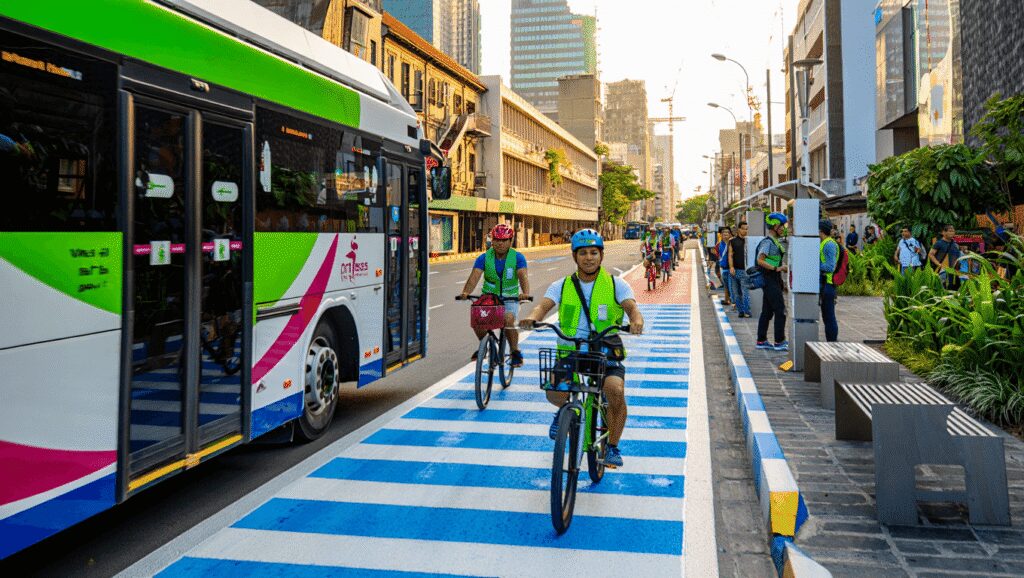
After years of citizen advocacy, Manila is reinventing its mobility: a national coalition pushed for concrete changes in public transportation, bike lanes and pedestrian space that are now attracting international attention. The movement, which emerged after the closures due to the pandemic, already influences investment decisions for billions and the daily lives of those who do not use a car.
What began as a response to the paralysis of public transport during confinement was consolidated into a network of organizations that today press for inclusive policies and more humane urban designs. The key group, known as Move As Onebrings together more than 77,000 people organized into 142 groups.
When the buses stopped running, it became clear how many families depended on the service to access their jobs and income. The economic fragility of transportation workers also came to light: without routes or passengers, many people’s livelihoods were cut off.
Concrete achievements and financial scope
The coalition’s sustained action—through testimony before Congress, visits to neighborhoods, dialogue at town halls, and public campaigns—has modified budget priorities and infrastructure projects. Researchers of the World Resources Institute point out that these actions have influenced the allocation of about 946 million dollars in immediate funds and in decisions linked to approximately 12 billion dollars in medium and long-term financing.
In the capital, part of those resources were redirected to visible projects: a pedestrian boulevard along the Pasig Riverthe partial pedestrianization of the historic neighborhood of Intramuros and a dedicated bus route on the main artery, the EDSAwith dedicated stations and better safe pedestrian access.
- More than 800 miles of bike lanes already connect neighborhoods in several cities across the country.
- Stations and stops designed to load and unload passengers in an orderly and accessible manner.
- Elevated and shaded pedestrian spaces to reduce the impact of heat and improve safety.
What does this mean for citizens?
For those who do not drive, the transformation implies greater access to employment, less insecurity when walking and transportation options designed for people with disabilities. For the local economy, the improvement of routes and the formalization of bus corridors stabilizes operator income and generates more predictable work chains.
Department of Transportation officials have recognized the operational role of the coalition: instead of seeing it only as a pressure group, they have incorporated it as a collaborative actor that provides information, mobilizes communities and facilitates the implementation of urban projects.
The intensity of change varies by city, but the pattern is clear: when users, civil organizations and authorities coordinate, investment decisions can become more equitable and oriented toward collective well-being.
International recognition and next steps
This citizen impulse has just received recognition: Move As One was selected among the five finalists of the WRI Ross Center Prize for Cities 2025-2026an award that makes visible initiatives that promote healthier and more sustainable cities.
The immediate future poses challenges: sustaining political pressure, guaranteeing the correct execution of works and expanding the infrastructure network so that the benefits reach peripheral areas. It will also be key to measure impacts on road safety, travel times and quality of life to justify new budget allocations.
In context, the Philippine experience offers practical lessons for other metropolises facing similar priorities: prioritizing pedestrians, cyclists and public transport users not only changes the urban landscape, but redefines who receives resources and with what social effects.
Similar items

Alonso Delgado covers the international news with rigor. You’ll find accurate and relevant reporting on major global events, from political crises to diplomatic breakthroughs.
You may also like
-
Mark Carney’s Liberal Party reaches parliamentary majority and will be able to govern Canada alone until 2029
-
The young people who grew up in Orbán’s Hungary and voted for Magyar to remove him from power: “We are making history”
-
“If Hezbollah accepts peace with Netanyahu, I myself will fight Hezbollah”
-
Roy Mackay: "Roberto Carlos did not control well because the field was a little bad, every March they tell me about that goal"
-
Hungary strikes down its populist laboratory