
How to avoid escalating the war without opposing it Donald Trump. This is the containment strategy that the countries counterattacked by Iran are following, including both those in the Gulf and those closest to Europe.
Türkiye, Cyprus and Azerbaijan have opted for containment after Iranian missile attacks launched in retaliation for the US-Israel war.
Although the greatest immediate burden and global consequences fall, for now, on the Gulf countries and the disruption of oil supplies through the Strait of Hormuz, the reaction of these three states is especially revealing. Its response combines containment, defensive reinforcement and geostrategic calculation.
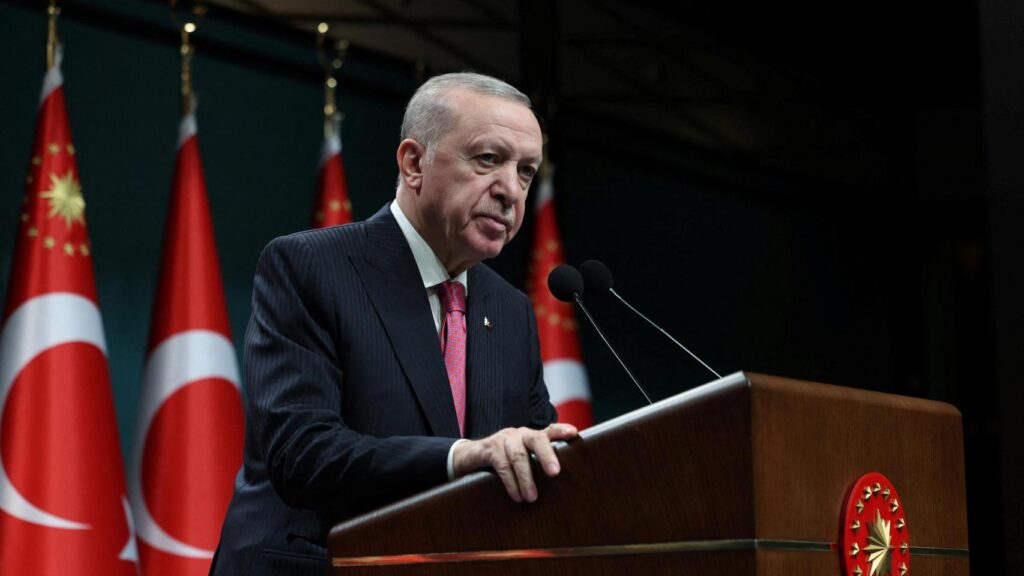
Ankara, with the largest NATO army in the region, seeks to prevent the collapse of Tehran more than to save the regime, despite having shot down a second Iranian missile on Monday with the help of the Spanish Patriots at the Adana base.
Türkiye threatened to act against this new attack, to which the Iranian president, Masud Pezeshkianhas announced an investigation to clarify the accusations it has received from Ankara.
Cyprus has gone from being a regional bridge to an advanced frontier of Europe and NATO in the war. And Baku, despite its structural hostility towards Tehran, avoids lighting a fire that overflows the Caucasus and damages its energy role.
For Europe and NATO there would be consequences if any of these actors decide to move from deterrence to punishment.
Weakened, not collapsed
Ankara has toughened its tone and reinforced its deployment, but continues to avoid offensive intervention, and is opting for defensive deterrence, not open war, since it has not asked for support to apply NATO Article 4, which would activate consultations to protect a member state.
The patience of Recep Tayyip Erdogan It depends on a specific red line: whether there are Turkish victims or attacks on strategic installations.
If Iran weakens, Türkiye gains preponderance in the region, like the one it has already acquired in Syria. But the balance is delicate, since he does not want Israel, the driving force behind Trump’s attack, to prevail.
But if the ayatollah regime collapses, it would be a nightmare for Türkiye. It would once again have a hostile neighbor on its border, and also a new wave of refugees (there are already some 300,000 Iranians on Turkish soil), the entry of militias and instability.
As the analyst indicates Sinan Ulgen In Project Syndicate, the preferable would be “a managed degradation” of its capabilities, avoiding a prolonged war and the fragmentation of the Shiite country.
The interested leak that Washington maintains contacts with Kurdish-Iranian militias to attack the regime on the ground, including the PJAK, has aroused the opposition of Ankara, since this group has contacts with the Kurdish-Turkish PKK, with which Erdoğan has been negotiating disarmament for months after decades of conflict and more than 40,000 deaths.
Within this framework is tactical harmony, not ideological, with Pedro Sanchezwhose opposition to interventionism has been amplified by the media related to the Erdoğan government, which are the majority. Türkiye formulates its rejection based on reason of state.
The most delicate case for Europe
It is because the war has already touched European territory. The coup in Akrotiri turned the island into an attack on European territory, even if it was on a British base.
Nicosia’s position coincides with the majority of countries that have been attacked by the Iranian counteroffensive: no one wants to enter the war and neither wants to antagonize Trump. So everyone is strengthening defense, intelligence and diplomacy.
In this framework, Nicosia has stressed that the target was the British base and not the Republic of Cyprus as such.
But the political effect has been enormous: France and Greece came to stage support and defensive reinforcement, and Emmanuel Macron He even said on the island that an attack against Cyprus is an attack against all of Europe.
That is to say, although Cyprus wants to stay out, Europe is already treating it as an advanced frontier of the crisis as a British, European and Mediterranean platform.
Azerbaijan, more hostile
Baku maintains a much more hostile relationship with Iran than Turkey, but a regional war does not suit it either, despite Tehran’s “suicidal escalation” in the Caucasus, as it explains Joseph Epstein.
“Tehran spent months publicly signaling that Azerbaijan was in its crosshairs, warnings that Western analysts largely dismissed,” this expert notes.
This country bordering northern Iran starts from a very different base: relations were already deteriorated by the attack on its embassy in Tehran in 2023, by the close relationship between Baku and Tel Aviv, and the geopolitical rivalry in the Caucasus.
However, even after harshly denouncing plots attributed to the Revolutionary Guard and threats against critical infrastructure, its response continues to be one of shielding and containment.
Azerbaijan distrusts Iran, but does not want to sacrifice the energy corridor or set fire to its surroundings.
A serious attack by Iran on the Southern Gas Corridor, to which Brussels attributes a crucial role in European energy security, would affect Europe less than the current disruption in Hormuz, but the blow would damage one of the few routes that Europe has promoted precisely to guarantee its energy security and to diversify its supply from Russia.
The gas supply to the EU through this route was 12.5 bcm in 2025, 53.8% more than in 2021.
In addition, the Baku-Tbilisi-Ceyhan (BTC) pipeline, whose capacity is around 1.2 million barrels per day, connects the Caspian with Turkey and the Mediterranean without passing through Russia or Iran. Baku said Saturday it had thwarted an alleged Iranian plot to attack it.
The EU would lose those volumes and insurance, transportation and markets would continue to become more expensive at a time when the war has already sent energy prices skyrocketing and made Europe nervous about inflation.
The damage would be especially sensitive for southern and southeastern Europe, where Azeri gas weighs more as a source of diversification than as absolute volume.
Consequences
Previous relations with Tehran explain a good part of the reaction of these three countries. Türkiye comes to this crisis from a cooperative rivalry: it competed with Iran, but traded with it.
Azerbaijan came from a structural mistrust, barely masked by timid attempts at detente, such as the visit of Iranian President Pezeshkian in April 2025.
Cyprus, which was not a direct rival, was a useful piece of regional diplomacy and increasingly relevant to the West. The war has put these positions under pressure.
If Turkey counterattacks in the event of deaths or the destruction of strategic facilities, the problem for NATO would be political, but it would not automatically drag the Alliance into a war against Iran.
The most likely thing would be a sequence of consultations, defensive reinforcement and strong allied pressure to avoid a further escalation, and the main question for the partners would be whether they want to accompany Ankara in what would surely be a surgical retaliation designed by Erdoğan so as not to appear weak.
Ankara’s most plausible response would be staggered, not massive. Before coming to blows, the sequence would include consultations with NATO, anti-missile reinforcement, targeted strikes and perhaps a hybrid or asymmetric response.
Europe and NATO, at risk
An escalation involving Turkey, Cyprus, Azerbaijan, or a tougher response by the Gulf States, which also show restraint, would mean further increases in the price of energy and marine insurance, due to the disruption of Hormuz and natural gas traffic.
It would also involve the militarization of the eastern Mediterranean and unleash divisions between allies. The war could not touch Berlin or Paris directly, and still completely disrupt European security.
In the hierarchy of impact on Europe and NATO, a counteroffensive by Turkey would have the greatest weight, due to being a member of the Alliance, due to its control of the Dardanelles (Mediterranean) and Bosphorus (Black Sea) straits, due to its military weight and because it hosts key allied assets.
Cyprus is also in that situation, because it connects the conflict with European and British territory.
Azerbaijan is relevant above all for energy and being in the Caucasus, but it does not have the same systemic and immediate impact as the attacks against Saudi Arabia, the United Arab Emirates, Qatar, Kuwait, Bahrain, Jordan, Oman and the Iraqi Kurdistan region.
What seems clear after more than ten days of war and the $100 per barrel of crude oil has surpassed due to the closure of Hormuz, is that the region does not want another Iraq, another Syria or another Libya.
The countries counterattacked by Iran do not embrace a logic of expansive war, which is why self-interested containment predominates. Nobody wants to give Iran victory, but neither does they want to inherit a regional disintegration with unforeseeable consequences.
You may also like
-
“We are interested in ensuring that the world is rules-based”
-
Senator Lindsey Graham asks Trump to take US bases from Spain for not supporting the war against Iran
-
Iran war and last minute of the US and Israel attacks, live
-
bets on its energy reserves with an eye on Taiwan
-
Israelis recognize the threat from Iran but accuse Netanyahu’s electoral calculation: “We are tired of wars”