
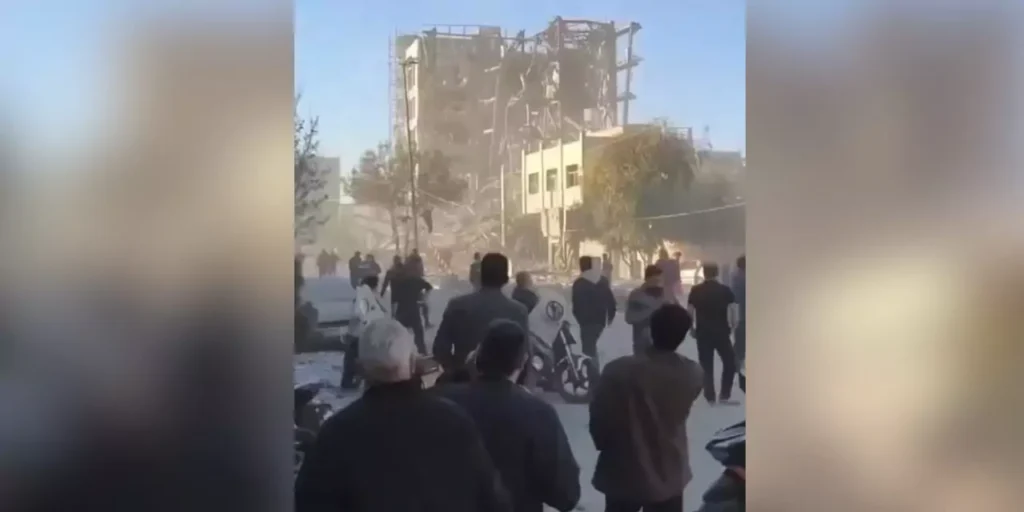
Israel launched an attack on the headquarters of the Assembly of the Council of Experts in Qom, south of Tehran, in a new episode of the military escalation that shakes Iran after the death of Ayatollah Ali Khamenei.
Local media reported that the attacked building houses the body in charge of appointing the country’s new supreme leader. According to the Axios portal, an Israeli Defense official confirmed that the bombing occurred while the votes were being counted.
“We wanted to prevent them from electing a new supreme leader,” said the official, quoted by the American media.
A BLOW TO THE SUCCESSION
The Assembly of the Council of Experts is the constitutional body responsible for appointing and supervising the supreme leader in Iran. It is made up of 88 religious members.
Until now, it is unknown how many councilors were in the building at the time of the attack and what the extent of the material or human damage is.
The Iranian Mehr agency, for its part, maintained that the bombed building is old and is not currently used for official meetings, which raises questions about the effectiveness or real objective of the operation.
DEADLINES AND KEY FIGURES AT PLAY
On Sunday, Iranian Foreign Minister Seyed Abbas Araghchi declared that the new supreme leader would be elected within two days.
After Khamenei’s death, Ayatollah Alireza Arafí assumed a relevant role by joining the Leadership Council as a legal member of the Council of Guardians, a body that supervises Parliament’s decisions and validates candidacies for public office.
The attack on the headquarters of the Council of Experts is interpreted as a direct attempt to alter the succession process in the Iranian political and religious leadership.
ESCALATION AFTER THE JOINT ATTACK
The offensive comes days after Israel and the United States launched a joint attack on Iran with the stated goal of “eliminating threats” from the Islamic Republic.
The bombings of February 28 led to the death of the supreme leader and several high-ranking military officers. In response, Tehran launched multiple waves of ballistic missiles against Israeli territory and against US bases in the Middle East.
According to official Iranian reports, the number of fatalities in the Persian country after the offensive exceeds 700 people.
RISK OF INSTITUTIONAL DISINTEGRATION
The attack against a key organ of the Iranian political system marks a critical point in the confrontation. Beyond the military impact, the action points to the institutional structure that guarantees the continuity of power in the Islamic Republic.
While Israel justifies the operation as a measure to prevent the consolidation of a new leadership, Tehran considers it a direct attack on its sovereignty and internal stability.
The outcome of the succession process and the Iranian response could define the course of a conflict that has already left hundreds dead and threatens to spread in the region.
You may also like
-
Donald Trump imposes historic tariffs on imported medicines and adjusts rates on metals
-
Trump fires Pam Bondi amid political tensions and pressure for judicial results
-
Iran denies Donald Trump about ceasefire amid escalating war
-
Russian oil breaks energy blockade and arrives in Cuba after months of shortage
-
Leo XIV bursts into Holy Week with a global message: “God rejects war”