
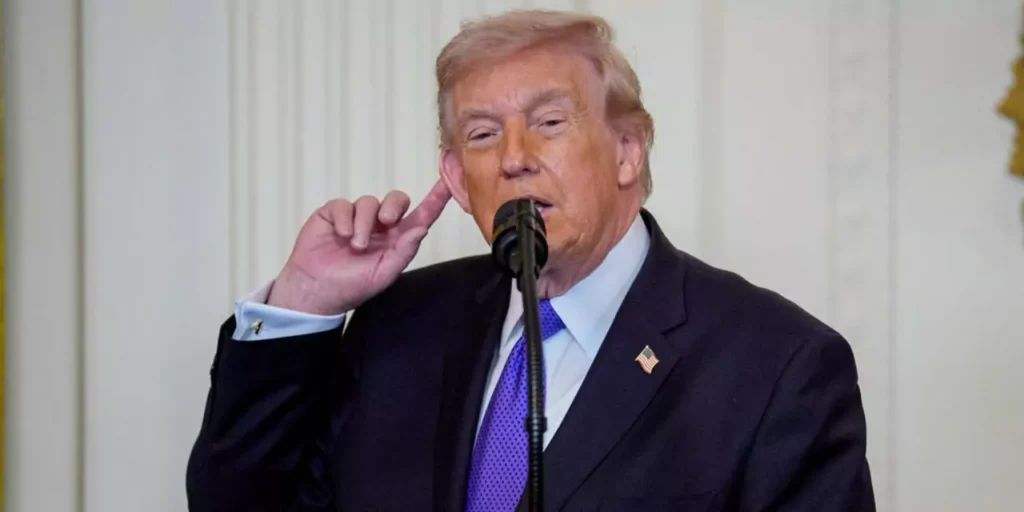
Iran’s response to the joint US-Israeli military offensive surprised Washington and revealed miscalculations in its assessment of the conflict. According to an analysis published by The New York Times, President Donald Trump’s government and its advisers minimized Tehran’s ability to react and the impact that escalation would have on global energy security.
The report maintains that the Iranian reaction was “much more aggressive” than during the so-called 12-Day War, a military offensive launched months earlier against the Islamic republic. For analysts cited by the media, the episode reflects the extent to which Washington had underestimated the perception of existential threat that the conflict represents for Tehran.
MISSILES, DRONES AND PRESSURE ON OIL
Following the initial attack, Iran responded with a series of military and strategic actions. Among them, the launching of missiles and drones against US bases in the region, as well as against Israeli territory and cities in Arab countries allied with Washington.
The most significant move was the closure of the Strait of Hormuz, a key maritime corridor through which approximately 20% of the world’s traded oil circulates.
The interruption of maritime traffic at this critical point caused an abrupt drop in commercial shipping and set off alarms in international energy markets.
EVACUATIONS AND IMPROVISED PLANS
As the situation deteriorated, Washington had to modify its plans on the fly. The US administration evacuated personnel from several embassies in the Middle East and began to design urgent strategies to contain the rise in gasoline prices.
The increase in energy costs, which officials initially considered a temporary effect of the conflict, has transformed into a more far-reaching economic threat.
IGNORED WARNINGS
Days before the military offensive, US Secretary of Energy Chris Wright had stated that any increase in the price of oil would be brief, recalling that during the 12-Day War values rose and then stabilized again.
However, according to the newspaper’s analysis, several government advisors privately shared that same perception, without giving greater weight to the warnings of experts who anticipated a possible closure of the Strait of Hormuz.
The seriousness of the mistake was exposed when Tehran threatened to attack commercial oil tankers passing through the area, exacerbating uncertainty over global energy supplies.
CRITICISM FOR LACK OF STRATEGY
The situation has also raised questions within the American political system itself. Senator Christopher S. Murphy harshly criticized the absence of a clear plan to reopen the sea route.
According to the legislator, the White House “does not have any plan” to guarantee the safety of transit in the strait, despite the fact that the risk of blockage was completely foreseeable.
Meanwhile, the report indicates that pessimism about the evolution of the conflict is growing within the government, although these doubts are rarely expressed publicly in front of the president, who has insisted that the military operation constitutes “a total success.”
You may also like
-
What is life like for Nicolás Maduro in his cell at the Metropolitan Detention Center in Brooklyn?
-
Two-ton missiles and regional attacks: conflict between Iran, the US and Israel escalates
-
Samuel Ramírez Jr., one of the 10 most wanted fugitives by the FBI, falls after almost three years on the run
-
New tension in the Caribbean? Russia supports Cuba in the face of pressure from the United States
-
“El Cuini” seeks agreement with US prosecutors and postpones hearing in Washington