
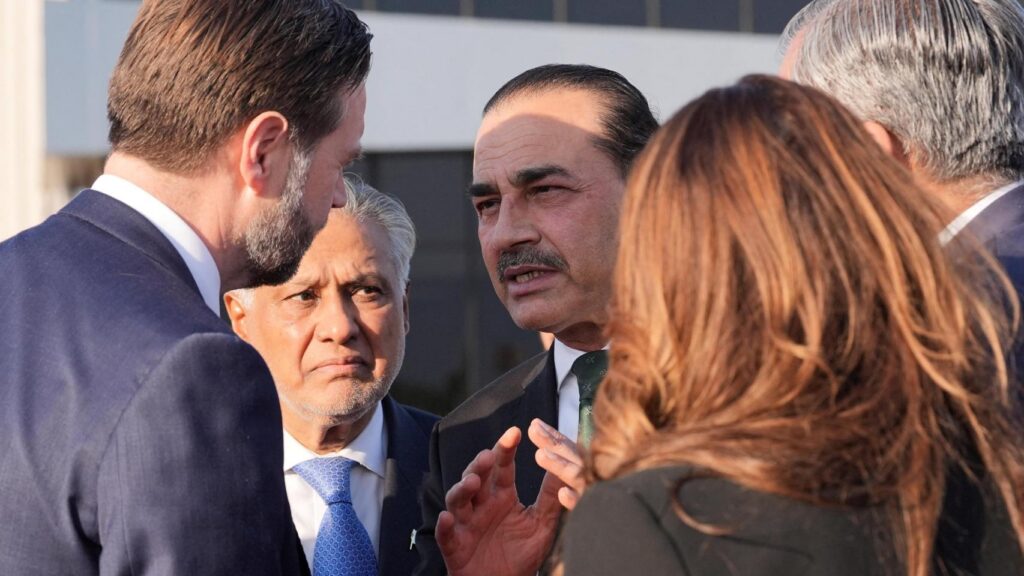
The Pakistani Field Marshal, Asim Munirarrived last Wednesday afternoon in Tehran with a message from Washington in his pocket.
Accompanied by the Minister of the Interior, Mohsin NaqviMunir was received at the airport by the head of Iranian diplomacy, Abás Araqchiin what Persian state media described as “a visit aimed at planning the next round of negotiations.”
The Pakistani soldier, promoted after mediating in the conflict between India and Pakistan last year, has become the most valued intermediary between two powers that have been killing each other for almost seven weeks.
Munir carried in his briefcase what sources close to the talks describe as a modified US proposal on the Iranian nuclear program.
Coincidentally—or not—forty-eight hours after his visit, Iran announced the reopening of the Strait of Hormuz.
The question is whether all these steps will be enough to prevent the ceasefire from expiring without an agreement on April 22.
Iran has softened its public positions on uranium enrichment. The spokesperson of the Ministry of Foreign Affairs, Esmail Baqaeisaid Tehran was “open to discussing the type and level of its uranium enrichment,” although maintained that the country should be able to continue such enrichment.
Meanwhile, Trump affirms that he will continue the naval blockade of all Iranian ports and threatens secondary sanctions on any country that trades with Iran.
It’s a fragile balance: The United States is demanding a 20-year moratorium on enrichment, Iran offered five in Islamabad last weekend, and now Munir must find a middle ground that allows both sides to claim victory.
The sources consulted by Al Jazeera They suggest that Pakistani mediators are “optimistic about a possible breakthrough on the nuclear front,” but warn that “there are people arguing on both sides.”
The latest rumor is that an agreement could be reached for $20 billion, something similar to the plan signed by Barack Obama which Trump denied so much at the time.
In statements to New York PostTrump himself praised the “great job” Munir was doing in moderating the talks. He thus made it clear to what extent the success or failure of these negotiations depends on his figure.
“Pakistan is the only mediator in this negotiation, although many countries in the world have offered their help,” he said. Caroline LeavittWhite House spokesman.
Iranian sources reported last Thursday of an imminent visit by Munir to Washington, although Pakistan has completely denied this.
Delighted to welcome Field Marshal Munir to Iran.
Expressed gratitude for Pakistan’s gracious hosting of dialogue, emphasizing that it reflects our deep and great bilateral relationship. Our commitment to promoting peace and stability in the region remains strong—and shared. pic.twitter.com/e74lm6hL8r
— Seyed Abbas Araghchi (@araghchi) April 15, 2026
The Kashmir Precedent
The relationship between Asim Munir and Donald Trump was forged in the four days in May 2025 when India and Pakistan came perilously close to nuclear war – or so the US president constantly claims – following the Pahalgam terrorist attack in Kashmir.
New Delhi accused Islamabad of supporting cross-border terrorism and on May 7, launched Operation Sindoor with missile strikes against militant group facilities in Pakistan and Pakistan-controlled Kashmir.
Pakistan responded with its own attacks, and for three days the subcontinent experienced the most dangerous military escalation since the 1998 nuclear tests.
That’s when Marco Rubio He started making phone calls: the Secretary of State spoke with the Pakistani Prime Minister, Shehbaz Sharifwith the Foreign Minister, Ishaq Darand, above all, with Munir.
The head of the Pakistani Army not only accepted the de-escalation proposal, but also convinced the political leadership in Islamabad to take the first step towards a ceasefire.
The following month, Pakistan nominated Trump for the Nobel Peace Prize for his role in the ceasefire.
Now, within the US Administration, it was understood that Munir had been the key. His ability to make quick decisions, communicate directly with civilian leadership, and maintain control over his own military during the crisis deeply impressed Washington.
Trump began referring to him as “my favorite quarterback” and “a great fighter.” Personal chemistry matters with Trump, and Munir has it.
“Thank you to Pakistan and its great Prime Minister and Field Marshal, two fantastic people!” he wrote this Friday in Truth Social.
Pakistan has deep strategic reasons for wanting peace in the Middle East, beyond the desire to please the American giant.
The country imports 85% of its oil, most through the Strait of Hormuz, which remains effectively closed by Iranian control.
Fuel prices have skyrocketed in Pakistan—gasoline now costs 40% more than before the war—and inflation is fueling social unrest in a country already suffering from a severe economic crisis.
Additionally, Pakistan maintains a strategic relationship with China, which also depends on the strait for its oil imports.
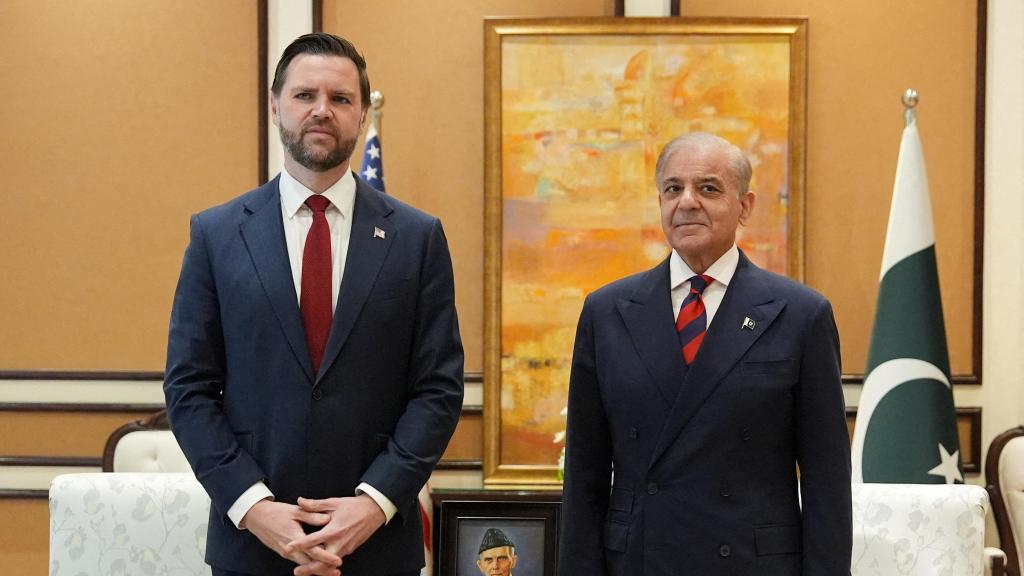
Pakistani Prime Minister Shehbaz Sharif, this Saturday at the meeting to discuss Iran, in Islamabad, Pakistan.
Accused of “state terrorism”
That said, the figure of Asim Munir is not free of controversies. Human rights activists have accused the field marshal of intensifying military operations in Balochistan under the pretext of combating separatism and protecting the CPEC.
The Human Rights Council of Balochistan (HRCB) documented 144 cases of enforced disappearances and 46 murders in February 2025 alone.
Mir Yar Balocha Baloch activist, wrote last December that “under the radical, militarized regime of General Asim Munir, Pakistan is trying to sell trillions of dollars worth of minerals and rare earth resources from Balochistan to foreign powers, while conducting massive military operations against the very people who own that land.”
The accusations go beyond political repression: they include aerial bombings, large-scale military operations and what critics describe as “state terrorism” to silence dissent.
The paradox is evident: the same man Washington celebrates as a peacemaker between the United States and Iran is accused by human rights groups of intensifying internal repression in his own country.
A Eurasia Review report from April 2025 noted that “under the current military leadership, military-citizen relations have only worsened.”
None of this seems to matter to Trump: he needs a mediator who can deliver results, and Munir has shown he can do that. The United States has plowed with worse oxen.
If Munir achieves an extension of the ceasefire this week, with or without a trip to Washington, he will have bought precious time.
If he achieves a framework agreement before the end of April, he will have achieved one of the most important diplomatic achievements of the decade.
Even if he fails, he will be remembered as the middleman who came close to peace but couldn’t close the deal.
Meanwhile, in Islamabad, they are already preparing the protocols for a second round of talks that could define the future of the Middle East and reorder diplomatic relations across the continent.
We will have to see how India and its prime minister take all this. Narendra Modi: It is not easy to see how your neighbor’s status goes from problem creator to problem solver.
You may also like
-
Saige Blair, the young victim of sexual harassment and abuse whom Trump has turned into a symbol of his anti-trans agenda
-
GAESA, the network of companies that hides the Castro fortune while Cuba faces shortages and blackouts
-
Iran opens Hormuz when Trump promises that it will unlock 20,000M if it delivers much of the uranium and stops Hezbollah
-
Lula and Petro follow in Xi Jinping’s footsteps and encourage Sánchez to remain in the “trench” against Trump
-
The Government formally asks the EU Council for a debate to vote on the break with Israel despite the ceasefire in Lebanon