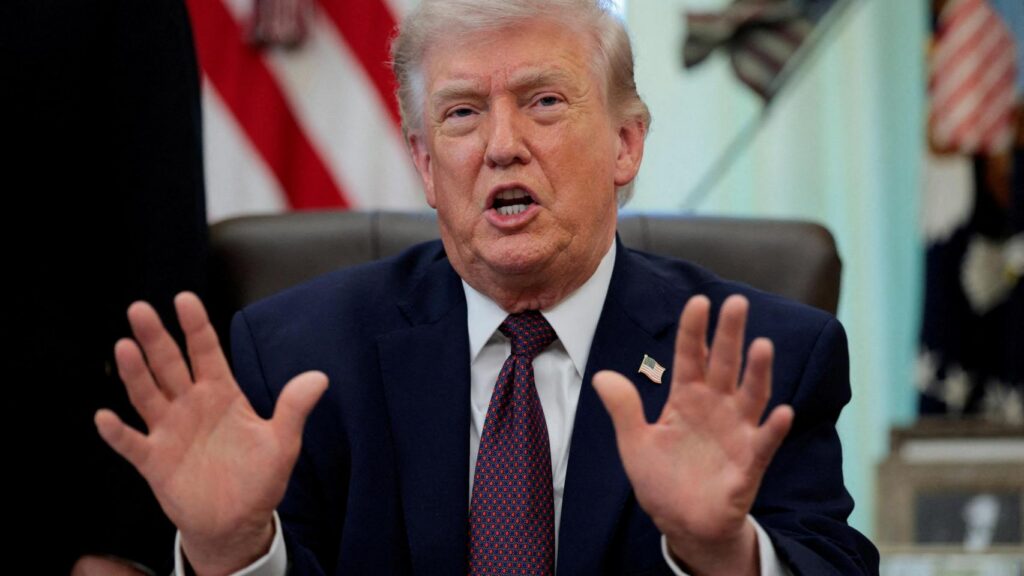
US President Donald Trump’s animosity towards the North Atlantic Treaty Organization (NATO) has reached the point of no return. The president is already openly proposing a future in which The US is not part of the Atlantic Alliance.
The resignation of several member countries lend their bases and airspace for Operation ‘Epic Fury’ – a military operation that was agreed upon with Israel and certain countries in the Persian Gulf, but not with NATO – has ended Trump’s patience.
The volcanic character of the New York magnate is known in Washington. Already in his first term, the establishment was aware of the profound effects that his mood swings could have in international politics.
In his first administration, Trump was forced to work with career officials who actively countered his arbitrary decisions. The legendary journalist Bob Woodward said that they reached hide documents from him in the Oval Office to prevent him from signing them.
The current situation is different, with a hand-picked Cabinet made up of unconditional faithful. Anticipating this situation, Congress provided itself with a tool to avoid what many feared: that Trump unilaterally removed the US from NATO.
Thus, in 2023, a bipartisan project was presented according to which the president of the United States had to obtain a majority of two thirds of the Senate to “suspend, terminate, denounce or withdraw” its participation in NATO. Alternatively, it had to obtain approval from Congress.
This proposal became law under the Section 1250A of the National Defense Authorization Act of 2024signed by Joe Biden. Thus, as the text specifies, Trump should first obtain the support of a qualified majority of parliamentarians.
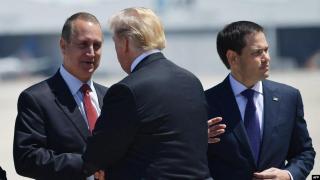
But the Capitol hides twists and turns for those who know how to take advantage of them. As an example, the Democrat who promoted the law to shield US participation in NATO was Tim Kaine. His republican counterpart was Marco Rubiotoday Secretary of State and one of the main defenders of punishing NATO for what they consider a rudeness.
Plan A: Invoke ‘presidential authority’
The US Constitution is riddled with ambiguities regarding the powers and duties that correspond to its president. Both the ultimate responsibility of directing the foreign policy of his country and the need to resort to parliamentary approval are some of them.
Thus, Trump could choose to invoke the concept of ‘presidential authority‘ and send in his own hand the withdrawal notification to NATO, which according to Article 13 of the organization would be effective one year later. There are precedents: this is how the United States withdrew from the World Health Organization (WHO).
The United States Congress could claim that the Act has been violated, but it would have to claim in court. And an uncertain scenario opens up, because Democrats and Republicans should reach an agreement to take the president to the Supreme Court. And even then, the High Court tends to be favorable to the president.
It is not an impossible option, because many conservatives advocate staying within the umbrella of the Atlantic Alliance. But as Ilaria Di Gioia, a legal scholar at the University of Birmingham, explains in Timethe most likely result would be a “confrontation between the Legislature and the Executive with the Judiciary as arbiter.”
The reality is that it would be enough for Trump to declare that the US withdrawal from NATO is a indisputable matter of National Security. And to do this, citing the Second Article of the Second Section of the Constitution, he could be invested with the powers of Commander in Chief, Di Gioia develops.
Plan B: Reduce NATO to irrelevance
But there are other kinds of legal problems that could arise from the unilateral breakup of NATO. Companies and entities that maintain contracts linked to the Atlantic Alliance could denounce Trump himself, as some harmed by the tariffs have done.
In addition, the process of notifying the withdrawal of the United States has a period of one year, during which they would still be obliged to comply with the obligations of the Treaty. A “soft” form of retaliation would then be to drag one’s feet and fail to fulfill commitments.
As Democratic legislators explained to PoliticalTrump could stop recognizing the representatives, withdraw its troops from joint operations y stop sharing intelligence and logistics with his allies.
At the same time, the Republican would have a free hand to flirt with NATO’s declared enemies as a measure of pressure. In his interview with The Telegraph, Trump stressed that not only he considered the Alliance a ‘paper tiger’: Vladimir Putin, he pointed out, also does.
You may also like
-
Putin begins a hidden mobilization to recruit thousands of soldiers in universities and factories due to casualties in Ukraine
-
Fertility rate in South Korea rises: small town celebrates first baby in 17 years
-
Trump declares victory in Iran, but announces new attacks in the coming weeks and leaves the end of the war in the air
-
NATO enters its biggest crisis due to Trump’s clash with Europe for refusing to enter the Iran war
-
Trump asks Denmark to go from one to four bases in Greenland to renounce its annexation