
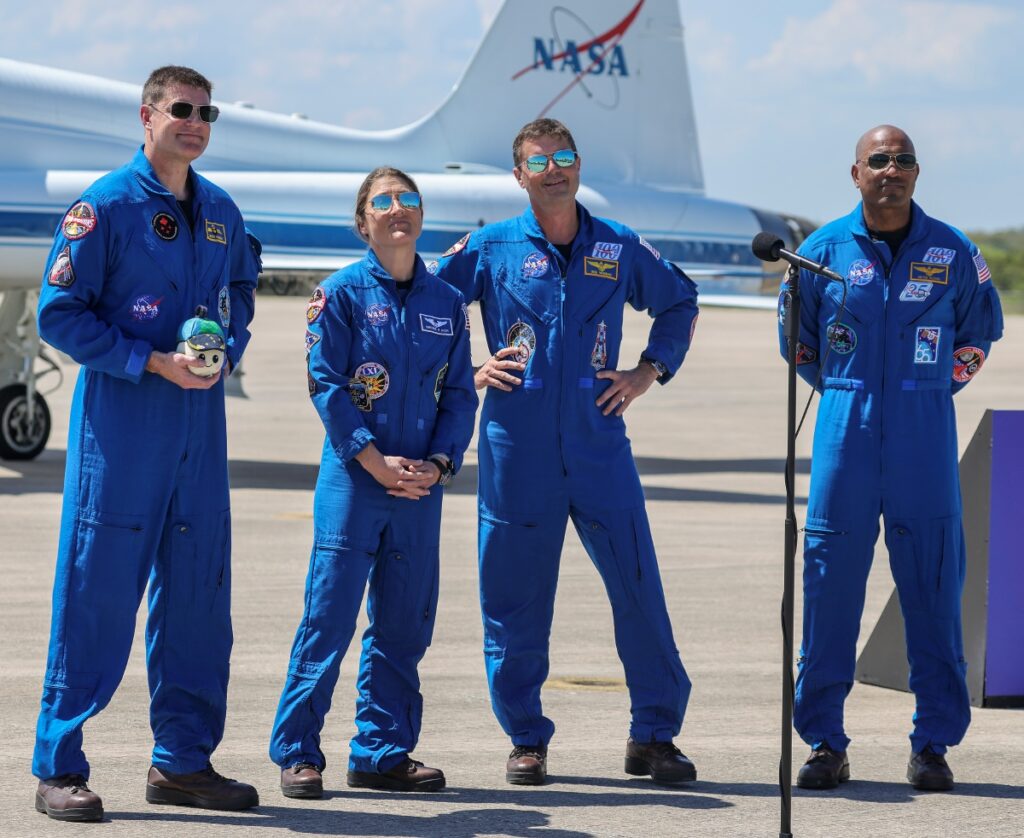
MIAMI (EFE).— The four astronauts who make up the Artemis II mission, which will involve the return of human beings to the Moon, arrived yesterday at the Kennedy Space Center in Cape Canaveral and declared themselves “excited” about the launch scheduled for next Wednesday.
“The world has waited a long time to do this again. We are really excited,” said mission commander Reid Wiseman, who highlighted that this is the result of years of work and the efforts of a large team.
The crew, which also includes Victor Glover, Christina Koch and Canadian Jeremy Hansen, arrived at the space complex in T-38 Talon training aircraft, normally used by NASA.
The four astronauts, who appeared before the media in their spacesuits on one of the landing strips, insisted that, although the mission is in its final phase of preparation, the schedule remains flexible. “The rocket is ready. We are ready. NASA is ready. But there are no guarantees,” warned Wiseman, who explained that delays of 24 or 48 hours could occur if the team needs more time or if technical or meteorological conditions arise.
Glover stressed that “we focus on training, preparation and safety.” He highlighted the role that families and the ground support team play in this entire process.
Artemis II has had several postponements in recent months due to technical and safety reviews, especially related to Orion spacecraft systems and other aspects of the program, which led NASA to delay takeoff to ensure flight reliability. However, the astronauts agreed that these delays have reinforced their preparation.
Koch highlighted the motivating impact of advances in the Artemis program and future Mars exploration. “It has been inspiring and has pushed us even further.”
The mission, he added, is like “a relay race (in which) we are only successful if the following missions are also successful.” He explained that Artemis II is a key step in paving the way for the moon landing, planned for Artemis III.
For his part, Hansen focused on international cooperation. “It’s not about being first, it’s about making sure we’re not last,” he emphasized, highlighting Canada’s partners and the European Space Agency.
Artemis II will be the first manned mission in more than half a century for a program that seeks to return astronauts to the lunar surface for the first time since the Apollo era.
The four crew members will travel aboard the Orion capsule on a flight around the Moon, with the aim of testing the navigation, communications and security systems before future lunar landing missions.
Manned flight also has a marked historical character. Glover will become the first black man to travel to the Moon; Koch will be the first woman to take part in a lunar mission, and Hansen, of the Canadian Space Agency, will be the first non-American to travel near the satellite.
The mission, which will include complex maneuvers and tests in lunar orbit, will also make it possible to collect key data on the spacecraft’s performance and the crew’s response in deep space, in what NASA considers a fundamental test before putting humans back on the surface of the Moon.
Related
You may also like
-
Samsung Wallet now activates the opening of house doors without taking your cell phone out of your pocket
-
The future that Apple designed before building it
-
Amazon activates massive offers: spring prime day with hundreds of thousands of discounts
-
Forget about full memory! WhatsApp 2026: How to activate file self-cleaning and “Two accounts” mode on a single cell phone
-
Android redesigns your contact list and boosts Messages and Gemini: changes you’ll notice today