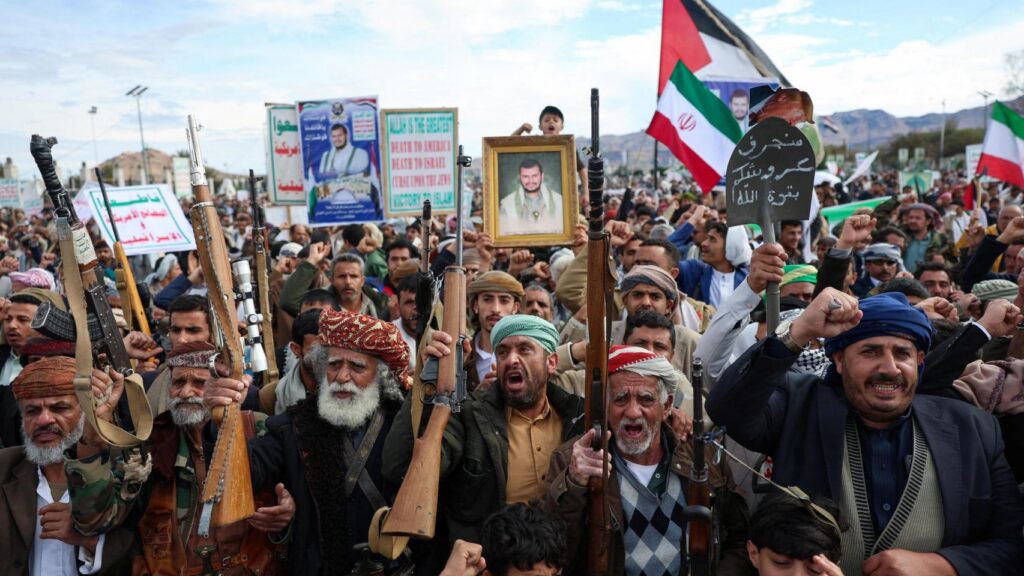
The Iranian regime, led by clerics with a radical vision of Shiite Islam Since April 1, 1979, it no longer represents a robust, resilient, modern, secular civil society eager for democratic freedoms.
Social discontent and the desire for regime change after the massacre of about 7,000 protesters (according to HRANA) in the protests of December and January, does not translate into united opposition, point out several Iranian analysts consulted by EL ESPAÑOL.
The hard core of support for the regime is 10%, according to the largest survey carried out so far, that of the group GAMAANbased in the Netherlands and whose method corrects the bias of censorship and fear.
The war started by the United States and Israel against Iran on February 28, which has already accumulated 1,500 civilian deaths (according to data from the Red Cross), has demonstrated a system of government designed to resistand a temporary closure of ranks.
However, opposition to the ayatollah dictatorship does not represent the entire society: It is highly fragmented between monarchists, republicans, the left and ethnic minorities, who, for the moment, do not seem to have the capacity to articulate a shared transition or a new balance of power to replace the regime.
The minorities most associated with the opposition to the Iranian regime are, above all, the Kurdish and the Balochand there are also dissident currents between ahwazi arabswhile the Azeris have not generally operated as an ethnic opposition bloc.
The problem, furthermore, is not only to overthrow the regime, but an alternative clear for the day after.
Fragmentation of the opposition
“There is no unified opposition. At this moment there is one figure much more visible than the others: Reza Pahlavithe son of the former Shah of Persia. But that doesn’t mean the opposition is united around him. Unfortunately, there is no coalition that brings together Pahlavi, to the left, to the Republicans, to the ethnic minority groups and to the regional parties”explains Ammar Malekidirector of GAMAAN and professor at Tilburg University.
Pahlavi is the most visible opposition figure, with a constant support of approximately one third of society in the last three years, while another third is opposed to it and the remaining third is ambivalent. Support for the Shah’s son is lower than the national average in ethnic provinces such as Kurdistan or Balochistan.
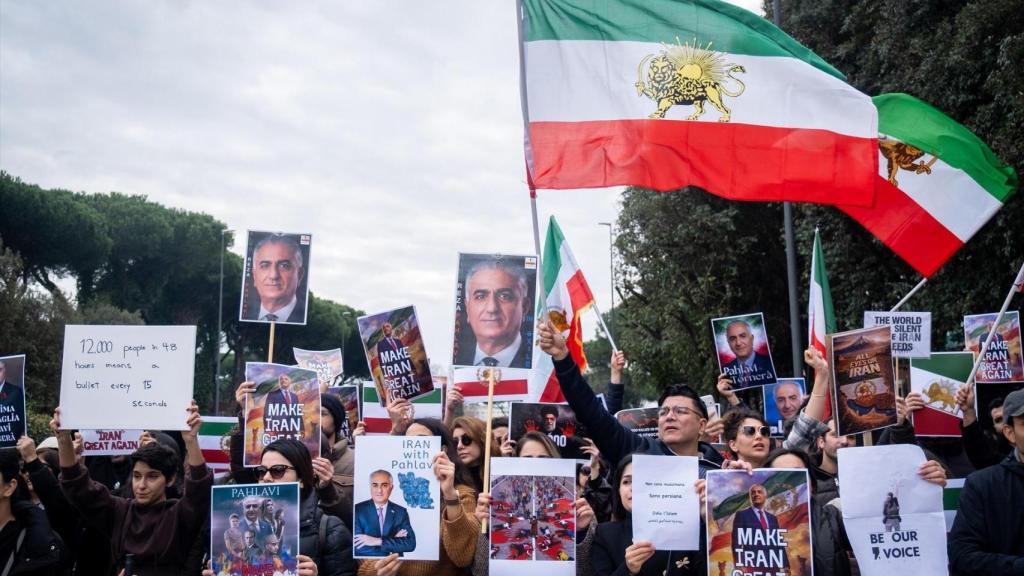
Iranian exiles in front of the Italian Ministry of Foreign Affairs in Rome demonstrating against the Ayatollahs’ regime and in favor of Shah Reza Pahlavi on January 15, 2026. Photo: Marco Di Gianvito / ZUMA Press Wir / Europa Press
Political preferences in Iran are varied: around 29% support the monarchyhe 21% a secular republic and the 15% some form of federalism.
Maleki emphasizes that, in a collapse scenario, popularity is not the only factor: armed capacity of groups such as the MEK (People’s Mujahideen Organization of Iran, an Iranian opposition group in exile) or Iranian Kurdish parties may outweigh popular support.
The influential analyst Governor Nasr, of the Johns Hopkins SAIS, holds in this interview that a significant part of the monarchist movement—particularly in the diaspora—not only seeks political change, but longs for a redefinition of Iranian identity. That is to say, rejects identification with the Global Southaspires to “integrate into the mainstream American and European”, and constructs a narrative that “stops the history of Iran in the 7th century”, before the arrival of Islam.
This group uses the support for Israel and antagonism to the Palestinian cause as mechanisms of symbolic integration with the West. This phenomenon, which Nasr describes as “the desire to be white”indicates that the monarchical opposition is not only a political option, but also a project of re-Westernization that generates tensions with other opposition sectors.
Coincide Djavad Salehi-Isfahani, professor of economics at Virginia Tech, in which the opposition is “deeply heterogeneous,” fractured by class, ideology, generation and geography.
“The frustration of the young generations has not led to a coherent progressive alternative, but rather has fueled a transversal rejection of both the establishment ruling and the reformist opposition, giving rise to a current of ‘anti-regime right’ who has called on Iran’s traditional enemies” to his rescue, adds Isfahani.
The opposition activist and analyst Kaveh Nematipour points out the limits of armed actors. The Iranian Kurds are the most mobilized ethnic-opposition group, with an estimated force of 50,000 to 60,000 men, but their lack of adequate weapons (mostly AK-47) and their inability to confront the Iranian army alone is highlighted. “These groups cannot decide the military outcome without external ground intervention,” he concludes.
The Trump administration is considering deploying ground troops for a possible operation on Jark Island.
Social support for the regime
get off provides more specific quantitative data. According to their September 2025 survey, around 20% of society supported the regime, subdivided into a 10% hardliners (loyalists to the IRGC Revolutionary Guard, and religious sectors) and other 10% from the reformist camp who still believed in changes within the system.
Narges Bajoghli, professor at Johns Hopkins SAIS, questions this analytical framework. He maintains that the social base of the regime is no longer stable nor is it defined solely by ideological conviction, which is a shrinking minority.
The analyst introduces two crucial categories. On the one hand, the structural dependencesince millions of Iranians whose livelihoods depend on state institutions. On the other hand, one reactive category that the war has brought to light: that of the Iranians who oppose the regime but react to a foreign attack as patriots. For Bajoghli, “confusing this national reaction with support for the regime is a analytical failure”.
The teacher Salehi-Isfahani agrees that the lasting social base of the regime is nourished by sectors of low incomereligious population and beneficiaries of the redistributive policies of the post-revolutionary social contract.
The transition horizon
Ali M. Ansari, member of the Royal Society of Edinburgh and professor at the University of St Andrews, emphasizes the resilience of Iranian society above that of the regime.
He maintains that what holds Iran together is its social and cultural base, not the state, and shows relative confidence that shared national identity can keep the country cohesive.
The resilience of the regime, he adds, lies less in ideology than in “the awareness that they have nowhere to go and fear the revenge of society”.
The war is distorting the usual political categories and activating a national reflex that does not align with loyalties to the regime, complicating the reading of civil society and opposition, he explains. Bajoghli.
get off presents a bleaker picture. Their main concern is the power vacuum. That is to say, the question is not only to overthrow the regime, but also to know who would replace it. Without a minimal coalition, the collapse could lead to civil war.
According to their data from after the 12-day war in June, only the 15% believed in the electoral route (since the electoral fiasco has unleashed numerous protests since 2009), the 33% in demonstrations and 20% in international intervention, “figures that have probably changed towards the latter option after the repression of the protests.”
For Nematipour, the most likely outcome would be a ground invasionsince neither internal armed groups nor aerial bombardments alone can defeat the Iranian army. He adds that the regime itself could be seeking to provoke this scenario, precisely because there it believes it can inflict more damage.
In the hands of the Guardians
The Revolutionary Guard would be a decisive actor for the future of the regime if it survives, Nasr suggests, with a dichotomy: on the one hand, a pragmatic reinvention, in which the IRGC could open borders, negotiate with the US and move towards economic opening without ceding authoritarian control.
And, on the other hand, a close the North Korean or Burmese stylewith which Iran would become a more closed, oppressive and impoverished society, in constant conflict with its neighbors and the US, comparable to Iraq between 1991 and 2003.

file oto. Members of Iran’s Revolutionary Guard during a ceremony commemorating the 40th anniversary of the 1979 Islamic Revolution, in Azadi (Freedom) Square in Tehran, Iran, on February 11, 2019.
Efe
Nasr is skeptical about the possibility of internal dissent: “Either the Revolutionary Guard as a whole makes a decision to negotiate with the US for a different future, or the country disintegrates and the Guard itself fractures along those lines.”
Relief scenarios
get off coincides with these two antagonistic models within the Iranian elite that has survived the death of Ali Khamenei. Khamenei’s faction and the Revolutionary Guard aspire to the North Korean model to maintain their total control and an isolated country.
What he calls the “chinese model” (pragmatic reinvention) is represented by figures such as Mohammad Bagher Ghalibaf (president of Parliament), or reformists like Hassan Rouhani (president 2013-2021) and Mohammad Yavad Zarif (his former Foreign Minister).
In fact, various media outlets have revealed this week that there are conversations between Donald Trump’s Administration and Ghalibaf.
“If the current military leadership is eliminated, these figures could emerge as an acceptable transition option for external actors,” Maleki suggests. And in parallel, it contemplates a scenario of collapse at the hands of armed opposition groups.
The final decision is with the IRGC, Nasr emphasizes. But the country’s continuity is not guaranteed, since the war could lead to territorial disintegration that would fracture the Guard itself.
For its part, Salehi-Isfahani It focuses on whether gradual social openings (such as the retreat from strict enforcement of the hijab) can be preserved. “The ability of the urban middle class to reaffirm a role in sustaining limited reforms will depend on this,” he concludes.
You may also like
-
they had threatened to kill her
-
Giant otter and 39 migratory species obtain cross-border protection: key decision at the UN
-
A Russian transport plane with 29 soldiers on board crashes in Crimea due to a technical failure: there are no survivors
-
The United States investigates how Noelia Castillo’s euthanasia was managed “due to possible system failures”
-
“It is the worst scenario since World War II”