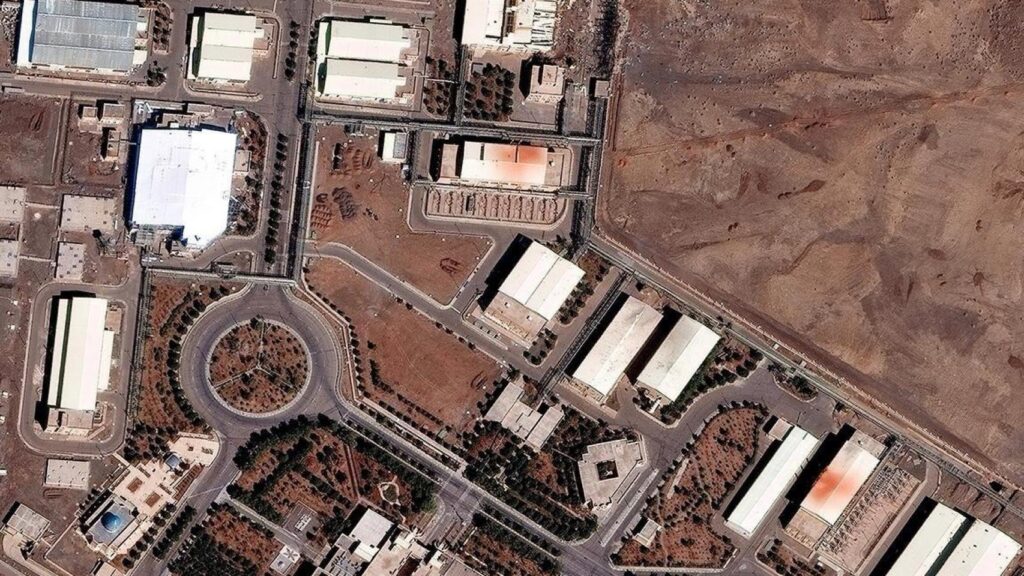
Iranian authorities have confirmed that The United States and Israel have launched an attack on the uranium enrichment center Shahid Ahmadi Roshan in the central province of Natanz, with no evidence of a leak of radioactive material at the moment.
“There is no evidence of any leak of radioactive materials in this complex and there is no danger to the residents of the surrounding areas,” the National Center for Nuclear Security System reported in a statement collected by the semi-official Iranian agency Tasnim.
The International Atomic Energy Agency (IAEA) has confirmed damage to the Natanz nuclear facilities.

“From the latest satellite images available, the IAEA can confirm some damage in the access buildings of the Natanz underground fuel enrichment plant (FEP), Iran,” the agency stated.
Likewise, he highlighted in a statement published on his social networks that “no radiological consequences are expected nor has any additional impact been detected on the FEP itself.”.
The general director of the agency, Rafael Mariano Grossi, has reiterated “his call for military restraint to avoid any risk of a nuclear accident,” reads the organization’s brief statement, published on social networks.
Iranian authorities have protested against an attack “contrary to international laws and obligations, including the Nuclear Non-Proliferation Treaty (NPT) and other regulations related to nuclear security.”
It is not the first time that the plant has been hit during the joint attacks that began on February 28 against Iran: three days later, the UN nuclear agency, the International Atomic Energy Agency (IAEA), confirmed damage in a bombardment against the facilities without any evidence of “radiological consequences.”
However, It was not damaged at that time. the fuel enrichment plant (FEP) as it did this Saturday and we must also remember that the plant was already one of the objectives of the joint operation launched by the US and Israel last summer and that hit the Islamic Republic for twelve days.
This attack on the Persian country comes a few hours after Iran will fire two ballistic missiles at the US-British military base of Diego García in the Indian Ocean, according to the semi-official news agency More.
He Wall Street Journal had announced that it was an intermediate range attack towards the base, but that they didn’t reach it since one of the missiles has failed in mid-flight and the other has been intercepted by a US Navy ship.
The Diego García Base, a strategic enclave for US operations abroad, is located almost 4,000 kilometers from the Iranian coast. Until now, Iran had unveiled a range of missiles with a maximum range of between 2,500 and 2,000 kilometers.
That’s why More He stated that attacking the base was a “significant step… that demonstrates that the Iranian missile range “It goes beyond what the enemy had previously imagined.”
Key piece
The Natanz nuclear plant—about 220 km southeast of Tehran—is the key node of the uranium enrichment program of the Persian country and a strategic piece in the dispute with international powers.
Its importance lies in the fact that concentrates a good part of the centrifuges capable of transforming natural uranium in material suitable for both civil and, potentially, military use.
Revealed in 2002 by Iranian opponents, Natanz was from the beginning at the center of suspicions about the true intentions of Tehran’s nuclear program.
Until then it had remained off the radar of the UN nuclear body, which fueled the perception of a project with possible military derivatives.
El complejo tiene además un peso estratégico porque buena parte de sus instalaciones están enterradas y protegidas para resistir ataques aéreos. Pese a esas defensas, ha sufrido ciberataques y sabotajes atribuidos a Israel, que buscan frenar el avance nuclear iraní sin desencadenar una guerra abierta.
En el plano diplomático, Natanz marca el tono de las negociaciones nucleares. Bajo el acuerdo de 2015, Irán se comprometió a reducir de forma drástica las centrifugadoras activas en la planta y a limitar el nivel de enriquecimiento, a cambio del alivio de sanciones.
Más allá del expediente técnico, Natanz tiene implicaciones regionales y globales. Para Israel y varios países árabes del Golfo, simboliza una amenaza directa; para Teherán, es el emblema de su derecho soberano a la tecnología nuclear y una palanca de presión frente a Estados Unidos y Europa.
Agreements and control
The 2015 nuclear deal (JCPOA) made Natanz the axis of the international control device over the Iranian atomic program.
In practice, the pact established that it would be the only plant authorized to enrich uranium on an industrial level for a period of 15 years, concentrating there the activities that it was previously suspected that Iran could disperse to other less guarded facilities.
He JCPOA set strict limits on the number and type of operating centrifuges at Natanz, as well as at the maximum level of uranium enrichment.
Iran pledged to retire thousands of machines, to use primarily first-generation models and to keep enrichment below the threshold considered for civilian use, thus reducing the risk of a rapid “escape” to military use of the program.
He Control of Natanz remained in the hands of the International Atomic Energy Agency (IAEA).which gained reinforced access to the plant.
Inspectors were able to install cameras, conduct frequent inspections, and check uranium stocks and the status of centrifuges, turning activity at the nuclear plant into a near real-time barometer of Iranian compliance or non-compliance with the deal.
Every time Iran has announced installing more advanced centrifuges or increasing the level of enrichment at Natanz, it has been interpreted as a direct response to the breaking or weakening of the JCPOA.
These movements at the plant have marked the successive crises of the pact and today condition any attempt at renegotiation: the degree of access and control over the nuclear plant will be one of the most sensitive points in any new understanding between Tehran and the powers.
After the United States exit from the JCPOA in 2018 and the reimposition of sanctions, the agreement entered into a drift that was immediately reflected in Natanz.
Tehran responded gradually by first announcing the failure to meet uranium reserve limits and then increasing the level of enrichment above the agreed 3.67%, in addition to installing more advanced centrifuges than those authorized.
These steps, which Iran justified as reversible and “proportionate” to Washington’s previous violation of the agreement, represented in practice the first clear violations of the 2015 framework and marked the beginning of the progressive emptying of the control regime over Natanz.
You may also like
-
Two humanitarian aid workers killed and two people injured in Russian drone attack in Donetsk
-
Spain achieves historic silver in the world premiere of the 4×400 mixed relay
-
Breaking news of the war in Iran today, live | US and Israeli attacks and latest news
-
OpenAI’s new judicial predicament
-
He refused to evacuate when Israel invaded Lebanon and died under bombs helping his neighbors