
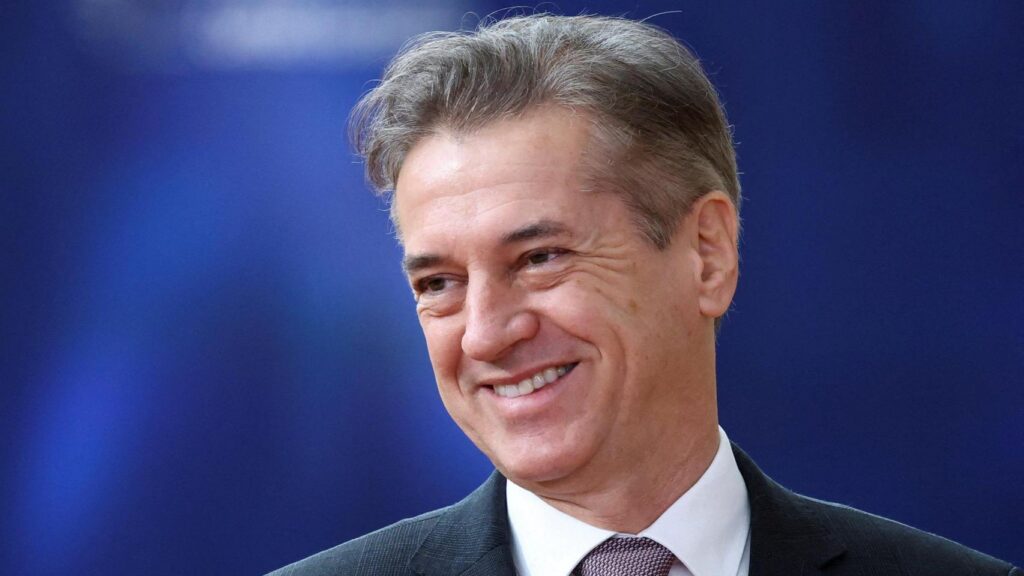
Slovenia faces parliamentary elections this Sunday under the shadow of espionagea term increasingly familiar in European countries.
The trigger for this suspicion of an attempt to influence the elections has been the presence of an Israeli company, Black Cube. This private intelligence firm is known for operating in political processes.
The Slovenian intelligence services have confirmed that members of the company were in national territory on dates prior to the elections.
What they have not been able to prove to date is whether they maintained contacts with political actors or the objective of these potential conversations.
Although there is no conclusive evidence, this issue has emerged in the middle of the electoral campaign.
This Israeli company, founded in 2010 by former members of Israel’s intelligence services, specializes, according to its website, in collecting information.
The current prime minister, Robert Golob, accused “foreign services” of interfering in the elections, while the Minister of Foreign Affairs, Tanja Fajonspoke of “a direct attack” on national sovereignty and “democracy.”

The Slovenian Executive recognized the State of Palestine in 2024, being one of the first European countries to take a stand for international recognition along with Spain. That is why the current prime minister criticizes that it is a Israeli interference in the elections.
But the scandal is not limited to its presence in Slovenia. The controversy broke out after the leak on social networks of secretly recorded conversations to different personalities, in which they supposedly suggested formulas to influence the Government.
The mode of influence stood out for its ability to speed up administrative procedures or facilitate the awarding of contracts.
Several of the people involved maintain that they were recorded without their knowledge during meetings with supposed investors and denounce that the material has been manipulated to compromise them and project the image of criminal practices.
Through a letter, Golob on Friday asked the president of the European Commission, Ursula von der Leyen, to investigate the accusations against Black Cube.
“Such interference by a foreign private company represents a clear hybrid threat against the European Union and its Member States, which negatively affects or potentially endangers our common values, procedures and political processes,” the letter states.
“It is worrying that this pattern of deceptive and coordinated behavior by a foreign non-state actor has occurred again just days before the national parliamentary elections, thus presenting systemic risks to Slovenia’s democratic processes,” he underlines.
Slovenian PM’s letter https://t.co/eCKDx6gjkn pic.twitter.com/Wg461pZBgy
— Martin Konečný (@MartinKonecny) March 19, 2026
An Orbán esloveno
In this Sunday’s elections, the current president, the pro-European Robert Golob, and the conservative opponent will measure their strength. Janez Janšain elections overshadowed due to these accusations of espionage that have fully entered the electoral campaign.
Although the polls show a very tight scenario, Jansa is the favorite to be re-elected prime minister of the country, after a period in the opposition.
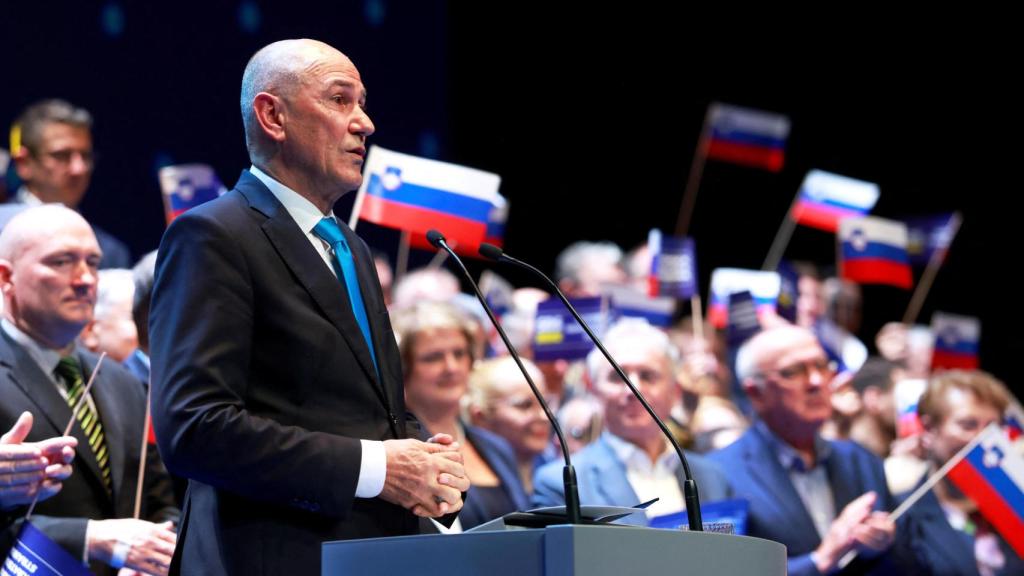
Janez Jansa, Slovenian opponent, at an election campaign event held in Ljubljana.
Reuters
The opposition leader, according to demographic studies last week, is the main candidate to be re-elected prime minister of Slovenia. a position he held in three different periods (2004-2008, 2012-2013 y 2020-2022).
In his first two governments he already showed populist ways, although his stance increased in his last period at the head of Slovenia.
In this final mandate he was especially critical of the independence of the press, the work of NGOs and judicial independence.
In addition, it also maintains a particularly critical position with the community policies of the European Union, to which Slovenia has belonged since 2004.
In this sense, Jansa bases its policy on denouncing an alleged centralism from Brussels and against the policies promoted from Brussels to fight climate change.
If re-elected, it could be a new headache for the EU, along with Hungary’s Viktor Orbán and Slovakia Robert Fico.
His main difference with Orbán lies in the international arena. While the Hungarian prime minister is the most reluctant to support Ukraine, in Jansa’s case he is completely opposite.
The former Slovenian prime minister has not hesitated to offer support to kyiv since the start of the war, since it considers that a potential Russian victory would endanger the security of Europe. In parallel, he also demanded that the Union should commit to including Ukraine as a Member State.
Regarding this alleged leak, he has come forward and assured that his political formation has nothing to do with this espionage company and that this issue is being exploited by the executive as an electoral weapon, despite the seriousness of the recordings.
The alliance with Sánchez
These elections also have an important role in Spanish national politics. A potential defeat of Golob, the current prime minister, would put an end to an alliance he has maintained with the president of the Government, Pedro Sanchez.
The understanding between the two has been built on clear ideological affinities, along the leftist line defended by both governments.
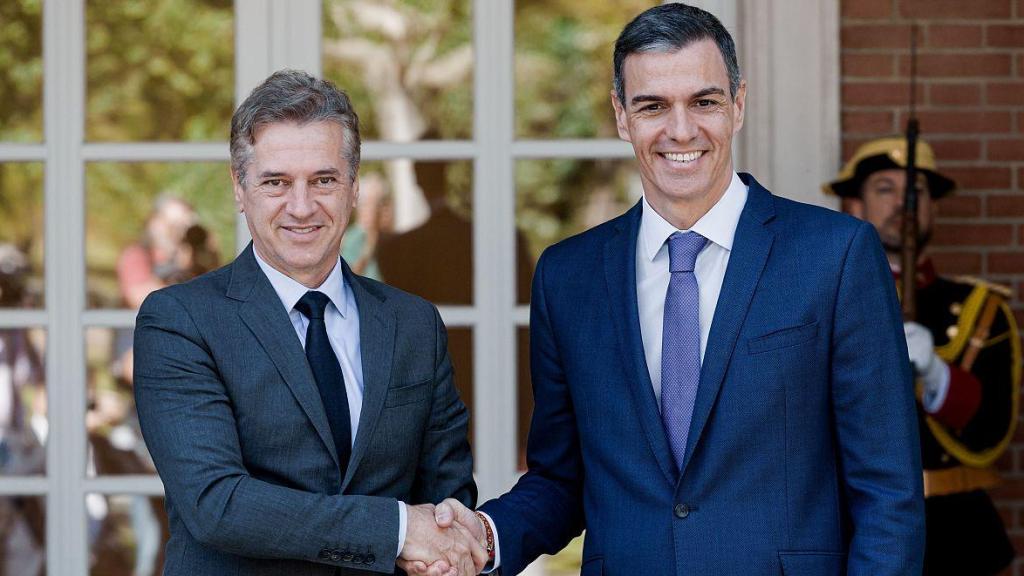
Pedro Sánchez with the Slovenian Prime Minister Robert Golov, on a visit to the Moncloa.
Europa Press
Since Golob came to power, he has held different meetings and meetings with the socialist president, with whom he has forged an important alliance on international matters.
The two have maintained the defense of progressive positions in social policy, alignment in strategic debates within the EU and coincidences in foreign policy, such as the recognition of the Palestinian State.
This axis, although discreet, is part of a broader network of European social democratic governments that seek to counterbalance the rise of conservative executives in Europe.
Currently, the Spanish Government can only find ideological similarities in countries such as Slovenia o Denmarkwhich have a social democratic government, although it has tried to maintain rapprochement with liberal executives such as that of Emmanuel Macron in France.
An eventual return to power Janša would upset that alliance. The conservative leader represents a vision much closer to the postulates of the illiberal European bloc, with critical positions towards Brussels and a political strategy based on confrontation with European institutions.
Janša is favorite
His party, Janša’s Social Democratic Party (SDS), and the ruling Freedom Movement (GS) are tied in the latest polls carried out in the days before the elections.
Although the polls point to a technical tie in first position, none of the candidates would reach 25% of the vote, the SDS could add 26 seats compared to 24, according to the main population surveys.
It seems clear that the two main parties will have to look for partners that will allow them to achieve the necessary parliamentary majority, set at 46 deputies of the 90 that make up the Chamber.
In this scenario, the result of the polls indicates an advantage for the SDS and other center-right formations, which would surpass the center-left bloc led by the GS by about five deputies.
In this way, the panorama is different from that reflected at the polls four years ago, when the formation of Golob won 41 of the 90 seats and managed to displace the SDS of the previous prime minister from power, which only had 27 deputies.
Golob later formed a coalition with the Social Democrats (SD) and Levica’s left, with a clear European orientation.
His Executive also stood out for his criticism of Israel for the attacks against the civilian population in Gaza after the Hamas terrorist attack on October 7, 2023, as well as his support for the formation of the Palestinian State.
For his part, the SDS leader is a defender of the state of Israel and also maintains a position in favor of a rapprochement with the president of the United States, Donald Trumpbeing one of the few European leaders who has shown his support for the American leader.
You may also like
-
War in Iran and attacks from the US and Israel today, live
-
Iran bombs the headquarters of Israel’s nuclear program in retaliation for the attack on the Natanz plant
-
he killed 2 girls with poisoned raspberries to get revenge on his lover
-
recognizes his mistake and fears punishment at the polls
-
Iran threatens to strangle trade through the Suez Canal as Trump mulls a de-escalation of the conflict