
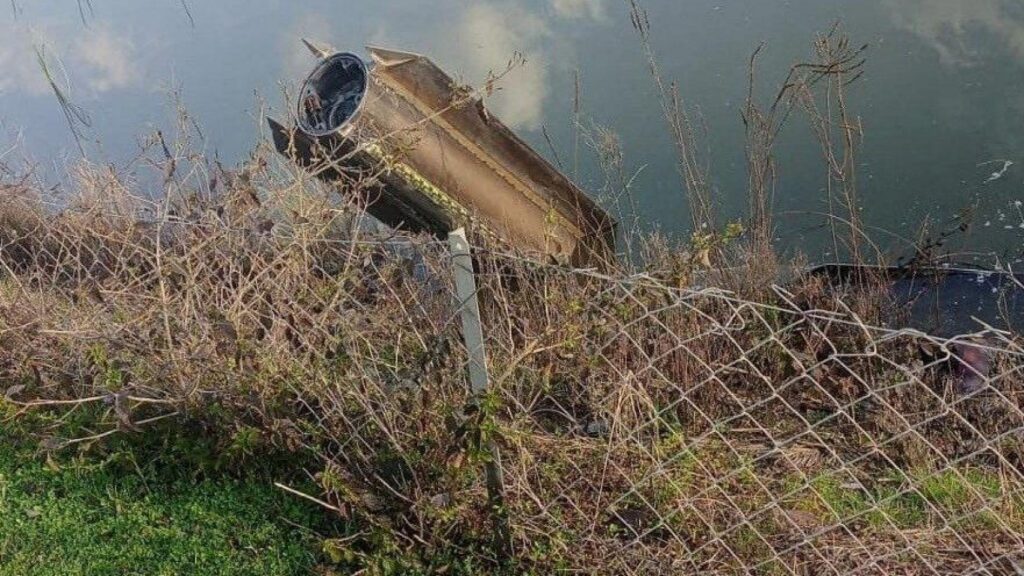
The Turkish Defense Ministry reported this Monday that a missile launched from Iran was shot down by NATO defensive systems when it entered Turkish airspace, in the fourth episode of this type since the war in Iran began a month ago.
“A ballistic missile fired from Iran and entering Turkish airspace was intercepted by NATO air and missile defenses deployed in the eastern Mediterranean,” said a statement from the Turkish Ministry.
The note does not specify the region in which the missile was intercepted or what its target could have been.
The first Iranian missile aimed at Turkey was intercepted on March 4 over the Mediterranean province of Hatay and remains of the interceptor rocket fell about 65 kilometers east of the Incirlik military base, used by NATO.
A second missile was intercepted on March 9, and one of its pieces hit near the city of Gaziantep, 170 kilometers east of the same base, while the third episode took place on March 13.
In that case, no impacts of debris were recorded, but numerous Turkish media reported that anti-aircraft warning sirens had been heard in the city of Adana, near where Incirlik is located, and images of a luminous body in the sky, supposedly recorded in that area, circulated on social networks.
Ankara has strongly protested to Tehran about these incidents, but the Iranian government denies that it fired missiles into Turkish territory and promises to investigate the incidents.
The Turkish Foreign Minister, Hakan Fidan, stressed on March 14 that his Iranian counterpart, Abbas Araqchi, had assured him that Tehran had not ordered these attacks.
“We are discussing with them the discrepancy between their statements and reality,” the Turkish minister said then.
Other missiles
NATO confirmed on March 13 that its air defenses had shot down a third ballistic missile fired from Iran toward Türkiye. “NATO remains vigilant and steadfast in the defense of all its allies,” said NATO spokesperson Allison Hart.
A few days earlier, Turkey announced on March 9 that NATO air defenses shot down a second Iranian ballistic missile that had entered its airspace and warned that it would take action against any such threat. The incident, which occurred in southern Turkey, involves the interception of a second missile from Iran in the last week.
Following that, Iran’s President Masoud Pezeshkian told his Turkish counterpart Tayyip Erdogan that Tehran is ready to form a joint team to investigate “allegations” of Iranian missile attacks against Turkey, Iranian media reported on Monday.
Unlike the first missile, which was shot down outside Türkiye, the second missile entered Turkish airspace. Its fragments fell in a region located between a strategic air base to the west and a radar base to the east, both used by the United States and NATO.
“We reiterate that all necessary measures will be taken decisively and without hesitation against any threat directed at the territory and airspace of our country,” the Turkish Defense Ministry stated, adding that there had been no casualties in the incident.
President Tayyip Erdogan stated that Türkiye had conveyed necessary warnings to Iran following the missile incident. “Iran continues to take wrong and provocative steps,” Erdogan said after a cabinet meeting in Ankara.
It was on March 4 that Turkey said NATO air defenses had destroyed an Iranian ballistic missile headed for Turkish airspace, marking the first time an alliance member was involved in the Middle East conflict.
Turkey, Iran’s neighbor that had attempted to mediate US-Iran talks before the air war, warned “all parties to refrain from actions that could lead to further escalation”, implying that it was not willing to request support from the transatlantic defense bloc.
He stated that Turkey would continue to take additional measures following the deployment of six F-16 fighter jets to northern Cyprus early on Monday, adding that Turkey’s main objective was to keep the country out of the “fire” of war with Iran.
You may also like
-
Israel passes law to impose death penalty on Palestinians convicted of terrorism
-
“I don’t think they are aliens, but demons”
-
Merz wants to return 80% in three years
-
A student enters his school armed with a shotgun, kills a classmate and wounds two others in northeastern Argentina
-
“It is a sign of respect towards the negotiations”