
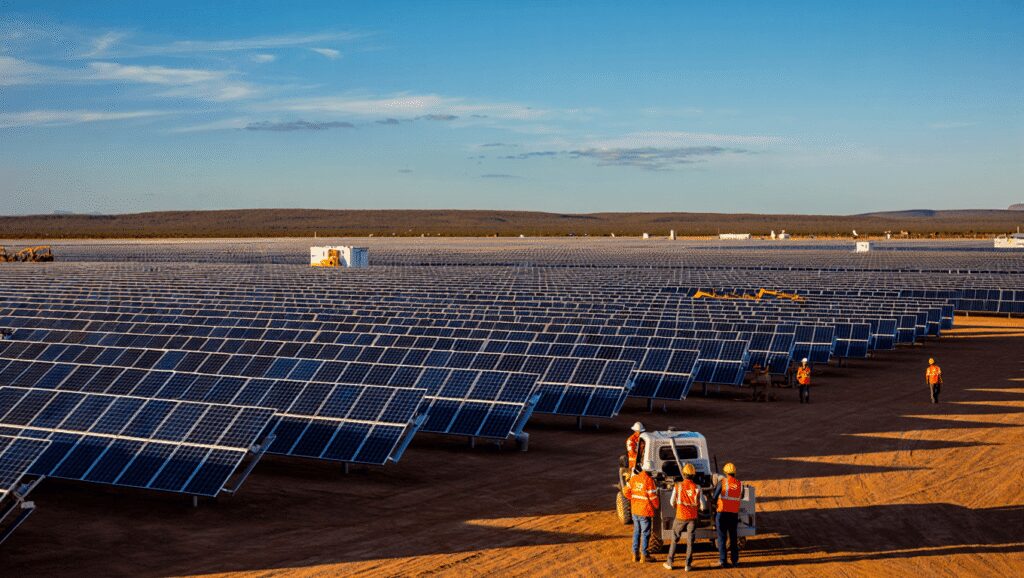
The federal government announced a solar expansion that seeks to transform the country’s renewable capacity and reduce vulnerability to international fuel volatility. The most ambitious work will expand the Puerto Peñasco plant to exceed 1 gigawatt, with integrated electrical storage and a start-up goal before 2029.
The Federal Electricity Commission (CFE) will allocate 30 billion pesos to promote solar projects that, together, will contribute around 1.5 gigawatts between generation and storage.
The central project consists of adding 580 megawatts to the power plant Puerto Penascolocated in Sonora, which will be configured as the largest solar installation in Latin America by surpassing the gigawatt barrier. Sonora was selected for its exceptional solar radiation: on average it receives between 300 and 350 days of useful sun per year.
In addition to photovoltaic capacity, the expansion includes batteries with an estimated participation of 30% of the total of the installation, to improve stability and allow more fluid dispatches to the national network.
In Coahuila another 556 MW will be added: 180 MW in Rio Escondido and 376 MW in Carbón II. Both projects will incorporate storage equivalent to 30% of their installed power, and CFE is already analyzing subsequent phases in Durango, Quintana Roo and Guanajuato.
- Approved amount: 30 billion pesos (approx. 1.62 billion dollars).
- Added capacity: 1.5 GW between generation and batteries.
- Main project: Puerto Peñasco, +580 MW to reach 1 GW.
- Other sites: Rio Escondido (180 MW) and Carbón II (376 MW) in Coahuila.
- Battery participation: ~30% per project.
- Term: all phases scheduled to finish before the end of 2028.
- Technical partners: Ministry of Energy (SENER) and National Infrastructure Fund (FONADIN).
In the official presentation, the CFE and the federal administration stressed that the initiative is part of a strategy to strengthen the energy sovereignty through “orderly, clean and sufficient” planning. To advance permits and technical details, tripartite committees were formed that will review the viability and status of prior authorizations.
The anticipated schedule—with all stages delivered by the end of 2028—poses logistical and regulatory challenges: adequacy of the network to inject new generation blocks, coordination with local authorities and execution of contracts for batteries, in addition to securing financing and supplies.
This boost comes in an international context of rising energy prices due to geopolitical tensions that have affected key hydrocarbon routes. For Mexico, with a population projected to grow and a growing middle class, increasing renewable capacity offers a way to reduce exposure to international fluctuations and meet future urban demand.
There is also an industrial component: Mexico is one of the largest producers of silver in the world, a relevant input in the manufacturing of photovoltaic panels, potentially facilitating local supply chains for the solar industry.
What to follow: the evolution of the technical studies of each project, the awarding of battery and panel contracts, and the effective integration of these parks into the operation of the national electrical system. The result will determine whether the commitment to more solar and storage achieves a real reduction in dependence on fossil fuels and greater resilience to external shocks.
Similar items

Alonso Delgado covers the international news with rigor. You’ll find accurate and relevant reporting on major global events, from political crises to diplomatic breakthroughs.
You may also like
-
The left bloc leads the Danish elections, but far from the majority, according to exit polls
-
Iran reopens the Strait of Hormuz for all “non-hostile” ships and from countries not linked to the “aggression”
-
The Supreme Court of Brazil grants house arrest to Jair Bolsonaro after his continued health problems
-
Their target, a German who supplies drones to kyiv
-
Bin Salman pressures Trump to continue war, conduct ground operations and overthrow the Iranian regime