
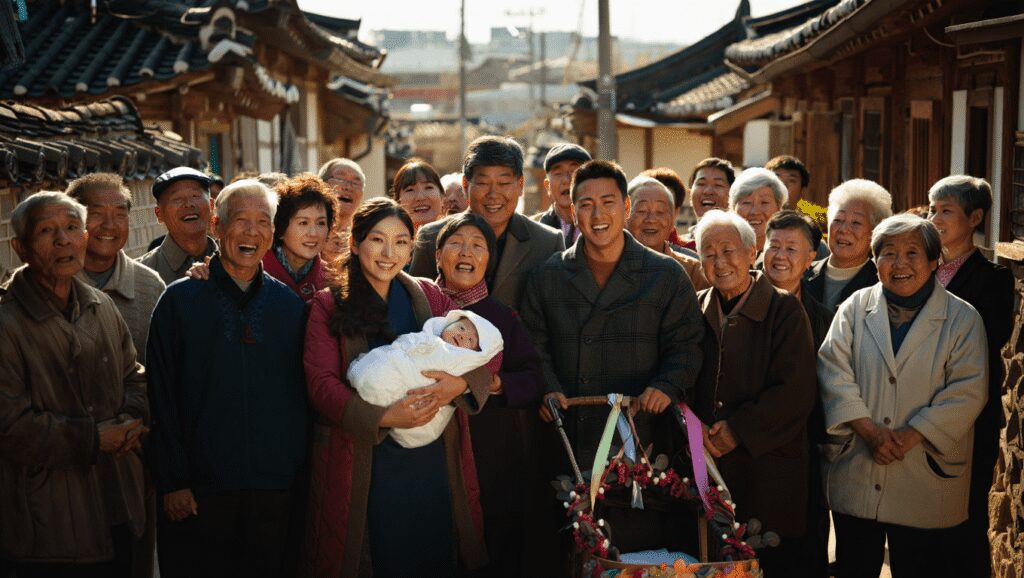
In a small rural town in South Korea this March they celebrated the birth of the first baby in 17 years, a fact that becomes relevant amid recent signs of demographic recovery in the country. The arrival of the child not only brought symbolic joy to the community, but also coincides with national indicators that point to a slight rebound in birth rates.
The baby, called Yong‑junwas born on March 19. His parents are Sreydani, an immigrant from Cambodia, and Jeong Hae-deok, residents of Eunha‑myeona town in Hongseong County that has seen its population decline in recent years.
In honor of the newborn, neighbors hung a banner on the main street announcing the good news, while the local school added four more students, bringing enrollment to 17 students — another demographic marker that residents celebrated.
- First birth in 17 years in Eunha‑myeon.
- Increase in school enrollment: +4 students, total 17.
- Recent population drop: from about 2,600 inhabitants to less than 2,000 in six years.
- Municipal actions: promises of administrative support for families.
The local mayor, Shim Seon‑jatold the newspaper Hankook Ilbo that the administration will intensify measures to make Eunha-myeon “a place suitable for raising children and an attractive place to live,” according to the quote published by the media. He did not offer concrete details about timelines or resources, but stressed the intention to prioritize services for families.
Why does it matter now?
Beyond the symbolism, the incident is part of a national trend observed in 2025: the fertility rate of the country experienced a year-on-year increase of 6.2%, while the divorce rate decreased by almost 9.8%. Those changes, while modest, have fueled debate over whether the demographic catastrophe predicted for South Korea may be, at least temporarily, on pause.
For rural communities like Eunha-myeon, each birth has practical effects: it keeps the school alive, drives demand for basic services, and helps sustain local social networks that otherwise weaken with migration to cities.
Demographic specialists point out that a single birth does not alter structural trends, but it can catalyze local policies and give confidence to other residents or potential new inhabitants. In this sense, public attention and the promise of municipal support act as factors that can influence family decisions in the short term.
In short, the first baby born in Eunha-myeon in almost two decades is both an intimate event and a mild indicator of change: it reflects how national movements in birth rates and family stability can have very concrete impacts in towns that have suffered sharp population decline.
Similar items

Alonso Delgado covers the international news with rigor. You’ll find accurate and relevant reporting on major global events, from political crises to diplomatic breakthroughs.
You may also like
-
Putin begins a hidden mobilization to recruit thousands of soldiers in universities and factories due to casualties in Ukraine
-
Trump declares victory in Iran, but announces new attacks in the coming weeks and leaves the end of the war in the air
-
NATO enters its biggest crisis due to Trump’s clash with Europe for refusing to enter the Iran war
-
Trump asks Denmark to go from one to four bases in Greenland to renounce its annexation
-
‘Presidential authority’, the ace in the hole that Trump can invoke to remove the US from NATO without going through Congress