
The keys
nuevo
Generated with AI
nuevo
Generated with AI
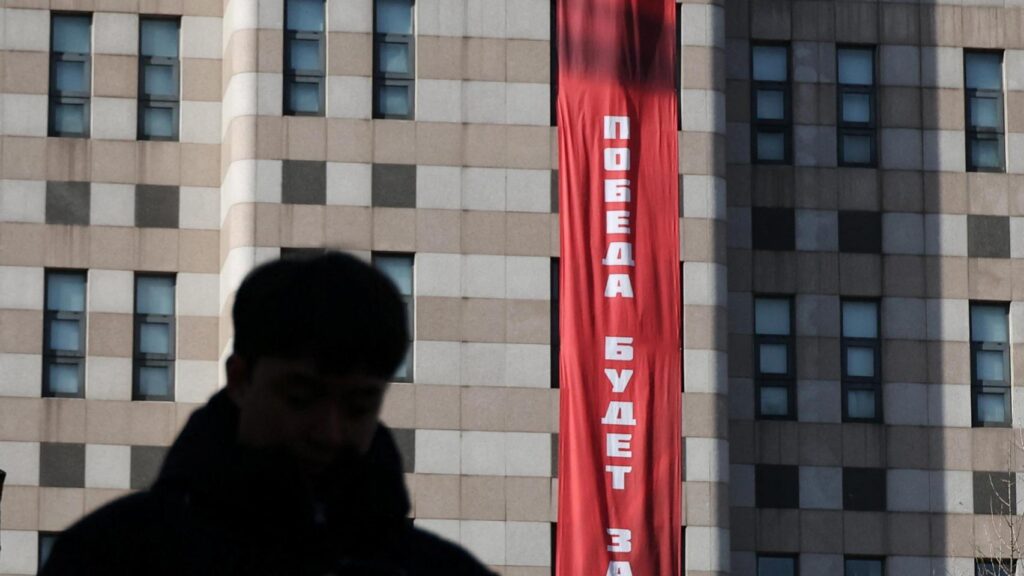
A huge sign with the motto “Victory will be ours”, placed on the facade of The Russian Embassy in Seoul has generated a new episode of diplomatic tensions between Russia and South Korea.
The message can be read from outside the diplomatic headquarters in the South Korean capital, where it was installed this Monday, coinciding with the week in which the beginning of the Russian invasion of Ukraine is commemorated.
The poster, visible from one of Seoul’s main avenues, was placed a few days before the fourth anniversary of the invasion, which increases its symbolic and political significance. According to diplomatic sources, the South Korean Government has shown its rejection of the message and has requested its withdrawal, warning that the message “does not contribute to stability.”

The South Korean Ministry of Foreign Affairs has formally conveyed its “concern” to the Russian delegation present in the Asian capital and has requested the removal of the poster, considering that the message could be interpreted as an exaltation of the war in Ukraine.
He Since the beginning of the war, the South Korean government has maintained a critical position with the Russian offensive. and has supported the condemnation resolutions approved within the framework of the United Nations (UN).
The placement of the banner also coincides with rising tensions on the Korean Peninsula and with Seoul’s warnings about military cooperation between Russia and North Korea.
The authorities of the Asian country oppose the Russian invasion of Ukraine and the recruitment of North Korean soldiers to fight for Russia.
The South Korean executive has been very critical of the close military cooperation between Russia and North Korea, considering that it “represents a danger to its population.” Kim Jong-Un himself, the North Korean dictator, has refused to improve ties with his neighbor, pointing out that “he is the enemy.”
This strong link has provoked harsh criticism from South Korea for the rapprochement between Moscow and Pyongyang, as they also consider that it violates UN Security Council resolutions, particularly if it involves the transfer of weapons or technology.
In this context, the South Korean Government has warned that this alliance may have “negative consequences” for bilateral relations with Russia and has reinforced its collaboration with the United States, especially in matters of security.
International echo
Although neither the United States nor the European Union have issued a specific statement about the cartel in Seoul, both maintain a firm stance condemning the Russian offensive and support diplomatic initiatives that question any manifestation of support for the war.
Western diplomatic circles consider that these types of gestures are part of the Kremlin’s communication strategy to project strength abroad.
The controversy occurs at a time of high global tension, with the conflict in Ukraine still active and with exchanges of attacks on different fronts.
In any case, the complaints of the Asian authorities do not go far, since, despite the formal protest, Seoul barely has room to force the removal of the sign without damaging the complicated relationship between both countries.
Las Diplomatic missions enjoy protection under international law and the host country cannot intervene directly in its facilities, so everything indicates that the solution will depend on a unilateral decision by the Russian government.
Meanwhile, the image of the slogan waving over the South Korean capital symbolizes how the war in Ukraine continues to project its effects beyond Europe, straining diplomatic balances in geographically distant, but strategically connected regions.
The Russian response
From the Russian Embassy in the capital Seoul, they maintain that the phrase is part of the traditional commemorations linked to Defender of the Fatherland Day and the memory of the Soviet victory in World War II.
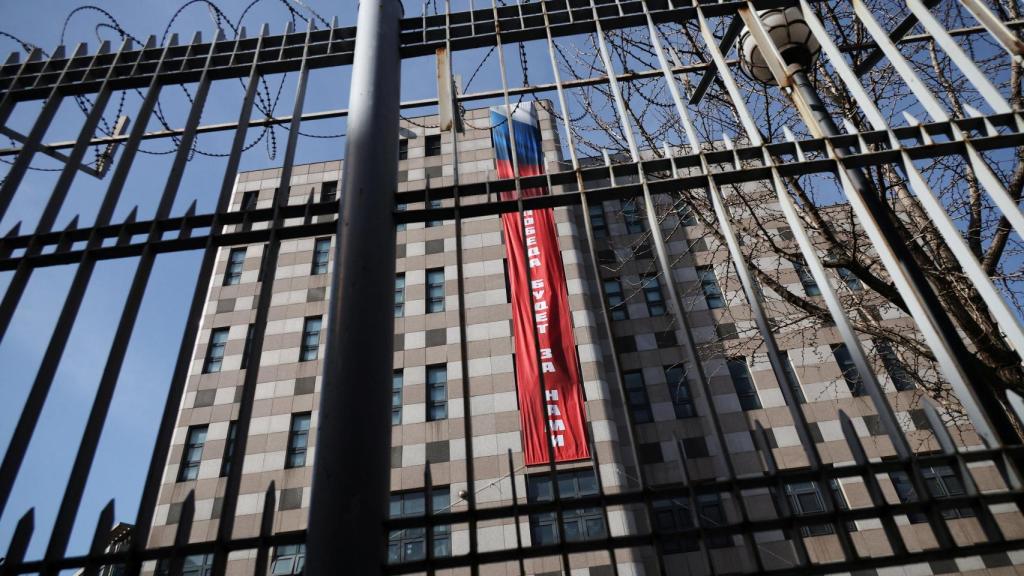
A banner reading “Victory will be ours” hangs outside the Russian Embassy, ahead of the fourth anniversary of Russia’s invasion of Ukraine.
Reuters
The motto “Victory will be ours” It has been used historically in Russia in patriotic and military contextsalthough since the beginning of the war in Ukraine it has acquired an unmistakable connotation associated with the current conflict.
Regarding this issue, Russian diplomats maintain that this is a message of a historical and national nature, not specifically addressed to the South Korean government.
In any case, the coincidence of displaying the banner in the days before the anniversary of the Russian invasion of Ukraine occurred is interpreted as a deliberate political gesture, which has fueled tensions.
In parallel, from the Seoul Ministry of Defense, they have reiterated their rejection of the Russian aggression against Ukraine that occurred in the early hours of February 24, 2022.
“The South Korean government has consistently maintained the position that the Russian invasion of Ukraine is an illegal act.” Indian Ahn Gyu-backthe main civilian responsible for defense and security in South Korea under the current Government.
The Ukrainian delegation has not yet commented on these events, nor has the president of Ukraine commented, Volodímir Zelenski.
You may also like
-
Protests shake Iran’s universities again a month after the repression that left more than 7,000 dead
-
A Russian botnet spreads ‘fake’ videos of actors pushing pro-Kremlin narratives
-
Frog extinct due to disease returns to nature: Discover the “spas” and “saunas” that saved it!
-
Consultations in the US on dual nationality increase by 183% due to democratic erosion and the climate of terror of ICE
-
Former Norwegian Prime Minister Thorbjorn Jagland, implicated in the ‘Epstein case’, hospitalized with a nervous breakdown