
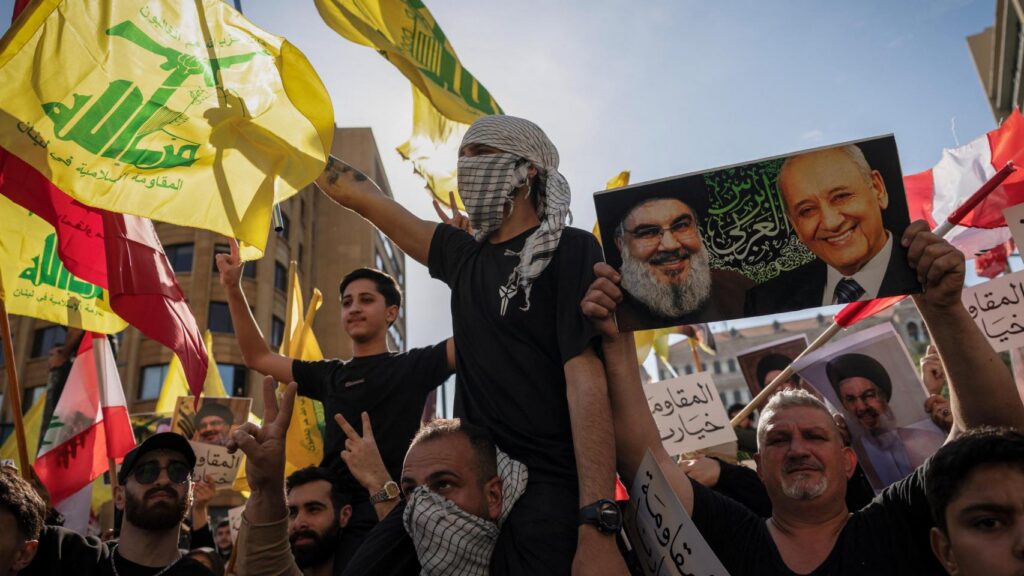
Israel and the Lebanese government will meet this week in Washington to negotiate a ceasefire. In the negotiations, Beirut will try to impose a definitive truce, while Tel Aviv tries to force the disarmament of Hezbollah.
The Lebanese Minister of Foreign Affairs, Yusef Rayyiargued this Monday that the negotiations will serve to decouple the conflict in Lebanon from the war in Iran and reiterated that the State is the only one with the capacity to speak on behalf of the country.
Meanwhile, discontent and distrust of institutions are palpable on the streets of Beirut after “Black Wednesday” in which at least 350 people were killed and 1,223 injured after Israel dropped 160 bombs in less than ten minutes throughout the country.
At the demonstration called on Saturday to protest against the negotiations with Israel, banners calling the Lebanese prime minister a “Zionist” could be seen. Nawaf Salamformer president of the International Court of Justice (ICJ).
Tents fill the Waterfront, the continuation of Zaitouna Bay’s boardwalk. Thus, the tents and yachts coexist in the same panorama, reflecting the contrasts of Lebanese society.
In it, runners run every morning between the tents in which displaced people live in an industrial estate where the largest nightclubs in the capital are located.
That’s where Um Haidar33 years old and mother of six children, whose house is in Dahie – that is, the suburbs of Beirut that are attacked almost daily – tells EL ESPAÑOL from the tent where she lives with her children that she does not believe in the truce, nor in Israel, nor in the Lebanese Government.
“Israel is treacherous and so is our Government. Nobody cares about the people. Nobody is with the people. We have not seen any minister or any deputy come to our side. They say we have a State, but where is it?” he bellows angrily with the youngest of his children, a four-month-old baby, in his arms.
She also explains that her husband is a member of the Lebanese Army, but that his salary of 120 dollars a month “is not enough at all”, especially for her, since one of her children has leg problems for which he has received four operations, for which he needs medical treatment and physiotherapy.
As if she didn’t have enough problems, in the event of an attack, she and her children are totally defenseless and have nowhere to go: “We live in constant fear: you are in the street and a bomb can fall at any moment.”
In addition to the risk of being murdered, there is also hunger: “An adult can last one or two days without eating, but a baby does not understand that there is no milk.”
To Mohameda 29-year-old Shia Muslim, negotiating with Israel is also not an option. “If Hezbollah accepts peace with Israel, I myself will fight Hezbollah. There can be no peace with Israel. They only understand the language of war,” he says with conviction.
“There will be no agreement. The best thing for us is to include ourselves in the ceasefire agreement with Iran. Because Iran has emerged victorious, under the umbrella of Tehran we will be able to get through it. But our beloved Government has decided that they have to negotiate directly with Israel,” he laments.
But his criticism does not end there: “I believe that our Government wants to show that if we are good and let ourselves be killed without resistance, Israel will not bomb us anymore,” he says ironically.
But he not only distrusts the capacity of the Lebanese Government, but also Israeli diplomacy: “It is when there are peace agreements that you are lost, because they, the Israelis, are very good at hiding terms.”
“Look what happened with the Oslo agreements,” Mohamed continues, recalling the agreements between the PLO and the Government of Israel signed in 1995 and which established the distribution of power in the occupied West Bank.
Dolores Rubioprofessor of International Relations at the Complutense University of Madrid, is very clear about the main failure in these negotiations: “The one who has to sit down to negotiate is Hezbollah, which is neither going to sit down to negotiate nor disarm, because it neither recognizes the Lebanese Government nor does the Lebanese Government recognize Hezbollah.”
Furthermore, Rubio adds, at this moment, the mediator, Washington, “cannot be considered impartial, since he is directly involved in this conflict.”
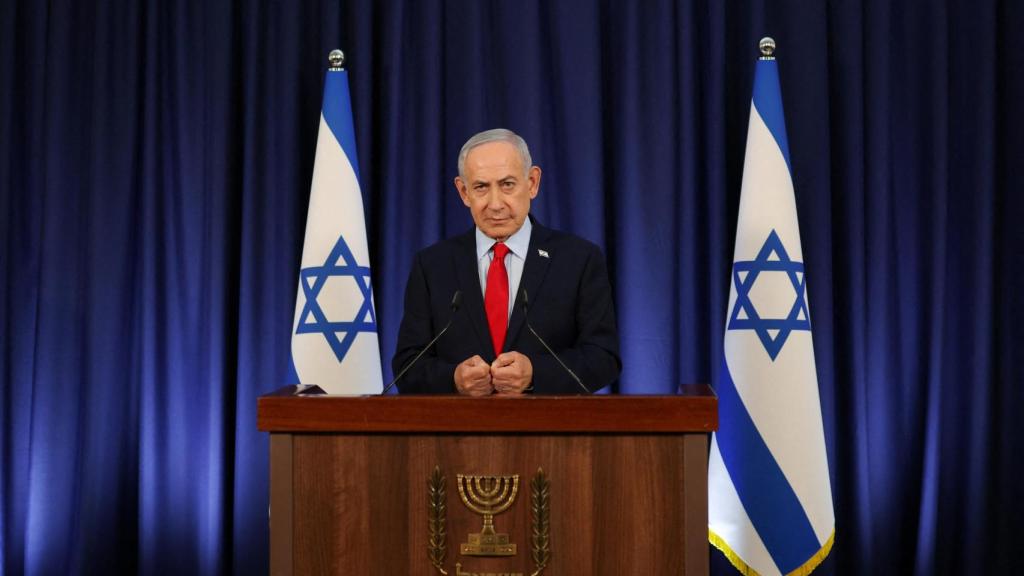
Israeli Prime Minister Benjamin Netanyahu at a press conference in Jerusalem.
Hezbollah, a weapon against Israel
The young Shiite goes on to explain that ordinary people who vote for Hezbollah or support the militia often do not do so for political reasons.
“They don’t care if Naim Qasem or someone else is in charge. What interests them is having this weapon with which to defend ourselves. We have sacrificed our beautiful land to have Hezbollah, to have this weapon to be able to defend ourselves from Israel,” he points out.
Asked about the possibility of a civil war, he is clear: “I think the best thing is for the Lebanese Army to include Hezbollah. But for this, you need a patriotic government.”
Alia taxi driver in his 50s, also sees no agreement in sight: “Disarming Hezbollah is impossible. The Government cannot achieve it.”
Ninoa Christian and owner of a cocktail bar on Armenian Street, affirms that, for him, the country’s biggest problem is the Palestinian refugees.
“Take them to Spain, you like them so much. After having them eat, drink and receive for 30 years without giving anything in return, we talked,” he says indignantly.
But if the hotelier doesn’t like the Palestinians, the Lebanese Government even less. Anger is visible in his eyes when I ask him about Prime Minister Salam, and he states that he prefers not to comment on the matter.
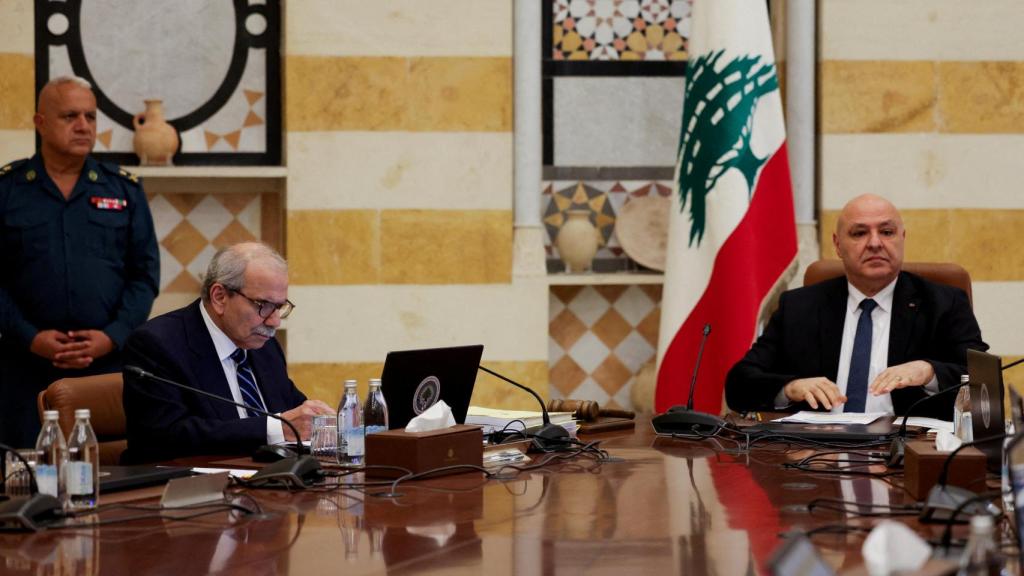
President Joseph Aoun and Prime Minister Nawaf Salam attend discuss efforts to put all the country’s weapons under state control, at the Presidential Palace in Baabda, Lebanon.
Reuters
Against a “Zionist” Government
Society’s rejection of negotiations with Israel is palpable in the streets of Beirut, where various demonstrations have been held throughout the weekend.
Without going any further, hundreds of people marched last Saturday in front of the Government headquarters in Beirut, the Grand Serail, to support Hezbollah and, as reported in the newspaper The Orient by Daythe march was also characterized by shouts against Nawaf Salam, who has been accused of being a “Zionist.”
This crisis of legitimacy caused the Lebanese prime minister to decide to postpone his trip to the United States to resolve his internal situation.
“In view of the current internal conditions, and in order to fully fulfill my duty to preserve the security of the Lebanese and their unity, I have decided to postpone my trip to the United Nations and the United States, to continue the work of the government from Beirut,” he declared last Friday.
As we see, a part of Lebanese society supports Hezbollah. As revealed by a survey conducted by the Washington Institute in 2023, support for Hezbollah is majority among Shiites, with 93% having a positive view of the militia, as well as 34% of Sunnis and 29% of Christians.
The position of the Lebanese Government and the militia is completely opposite.
While the yellows—the informal nickname they receive due to the color of their flag—continue to fight against Israel without respite or rest despite the ongoing negotiations, the Lebanese Government opts for dialogue with the Jewish State.
To give an example, the Ministry of Information in Lebanon warned the media that they cannot use the word “enemy” to refer to Israel or “resistance” to talk about Hezbollah when covering this war, according to the media. Al Araby.
In any case, the Lebanese are clear: they feel abandoned and distrust the institutions of the State, which they consider weak and incapable of dealing with internal problems.
“If you want to negotiate, you need something powerful, something strong to offer to negotiate. We have nothing,” concludes Mohamed.
You may also like
-
Tehran once again closes the Strait of Hormuz to navigation due to the naval blockade imposed by Trump
-
Bellini: masterpiece in Venice is restored before visitors with live video
-
Saige Blair, the young victim of sexual harassment and abuse whom Trump has turned into a symbol of his anti-trans agenda
-
GAESA, the network of companies that hides the Castro fortune while Cuba faces shortages and blackouts
-
Field Marshal Asim Munir consolidates himself as a bridge between the US and Iran