
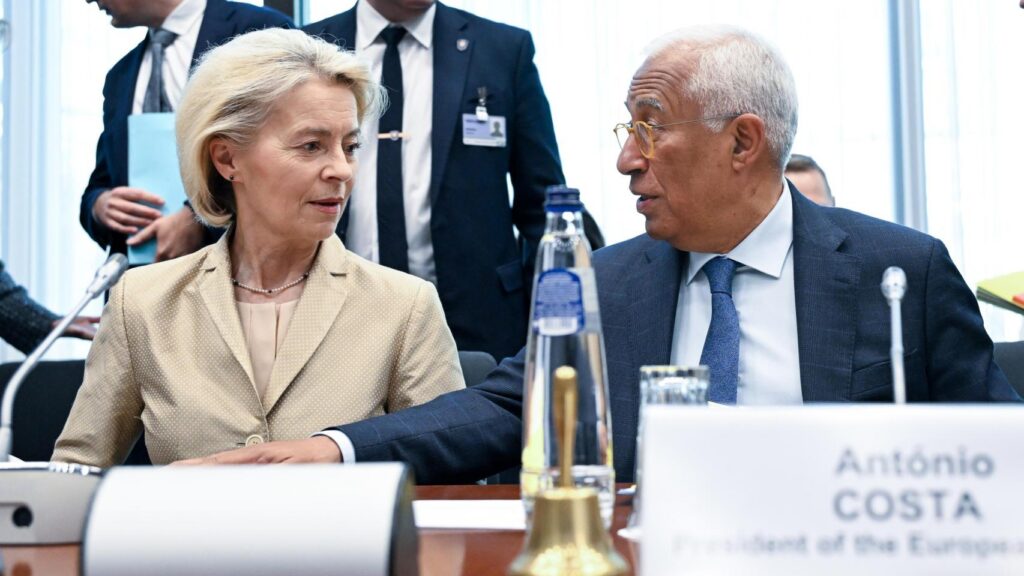
After a beginning marked by internal divisions – between the ‘no to war’ of Pedro Sanchez and the German’s ‘this is not the time to give lessons to our allies’ Friedrich Merz-, the chaos and lack of strategy from the White House have led in recent days to a posture approach among European leaders.
This convergence was evident in the Foreign Council on Monday, where the Twenty-Seven flatly rejected Trump’s request to intervene militarily in the Strait of Hormuz, through which nearly 20% of the world’s oil transits. ““This is not Europe’s war.”settled the head of community diplomacy, Kaja Kalla.
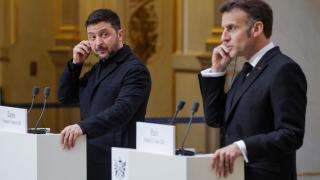
In this sense, European leaders will ask this Thursday for “a de-escalate and maximum containment, the protection of the civilian population and civil infrastructure, and the full respect of international law by all parties”, as contained in the draft conclusions to which this newspaper has had access.
“The EU is ready to contribute to all diplomatic efforts to de-escalate tensions and achieve a lasting solution that ends hostilities, prevents Iran from acquiring nuclear weapons and curbs its destabilizing activities, including its ballistic missile programme.”
At the same time, European leaders are already suffering the economic impact of the war, with a sharp rise in energy and fuel pricesand they are looking for how to reopen the Strait of Hormuz as soon as possible without being dragged into Trump’s war.
“The European Council recalls the need to safeguard regional airspace and ensure maritime safety and respect for freedom of navigation, and condemns any act that threatens navigation or prevents ships from entering and leaving the Strait of Hormuz“says the draft conclusions.
The leadership has been assumed by the French president, Emmanuel Macronwhich however insists that “France will never participate in operations to open or liberate the Strait of Hormuz in the current context.”
“However, we are convinced that once the situation calms down, that is, when the most intense attacks cease, we will be prepared, together with other nations, to take responsibility for an escort system“, explained this Tuesday the French president.
“We have already started exchanges with India, with several European partners and with other countries in the region. This work will involve discussions and coordination with Iran, because In no case can it be an operation by force“Warns Macron.
For his part, the German chancellor said this Wednesday before his Parliament that he is in almost daily contact with Macron, but also with the Italian Giorgia Meloni and the british Keir Starmerto discuss possible solutions.
“If the right conditions are met, we will not shy away from a debate on freedom of navigation, for example in the Strait of Hormuz, once the war is over,” Merz said.
Also the Secretary General of NATO, Mark Rutteassures that the allies are jointly discussing how to guarantee security in the Strait of Hormuz. “We all agree, of course, that commerce must be reopened,” he stressed.
For now, the President of the Government has ruled out any involvement of Spain in the reopening of this maritime route, vital for the world economy.
Energy rise
Regarding the economic impact of the war, European leaders will focus the discussion on how to alleviate the energy bills of homes and companies in the short term, just on the eve of Pedro Sánchez presenting a first aid package for the most affected sectors.
Since the beginning of the conflict, Europe has already spent an additional 6 billion euros in the import of fossil fuels, “a direct reminder of the price we pay for our energy dependence”, as Ursula von der Leyen has highlighted.
The President of the Commission recommends to the Member States “avoid premature withdrawal of assets, such as existing nuclear power plantswhich can continue to supply reliable, cheap and low-emission electricity.” A request that the Sánchez Government has already ruled out, maintaining the planned schedule for the nuclear blackout.
Although Von der Leyen has also suggested cutting taxes and fees on electricity, at the same time she insists that the aid packages designed by governments must be “temporary and selective and minimize fiscal costs”.
But the issue that most divides European leaders is the future of the European CO2 market, which represents 11% of the cost of the electricity bill. Meloni requests its temporary suspension to lower prices and has already managed to gain the support of Poland, Austria, Croatia, Greece, Hungary, Romania, Bulgaria, the Czech Republic and Slovakia.
On the opposite side, Sánchez has signed a joint letter with Denmark, Finland, Sweden, Portugal, the Netherlands and Slovenia in which he defends keeping the EU emissions trading system intact.
“Attempts to weaken, suspend or limit the ETS would undermine investor confidencethey would penalize those who have gone ahead, they would distort the equality of conditions and would slow down the transformation of our economies“, warns the text.
Ukraine
Despite the war in Iran, European leaders will insist that the main threat for the security of the continent remains the Russian aggression against Ukraineand will reiterate their commitment to maintaining political, economic and military assistance to kyiv.
The exception is once again Hungary Viktor OrbánVladimir Putin’s greatest ally in Brussels, who remains firm in his veto of the 90 billion EU loan to Ukraine and the twentieth package of sanctions against Moscow.
Despite the latest round of concessions announced by Von der Leyen, community leaders believe that Orbán will keep your block and they resign themselves to waiting for the results of the Hungarian elections on April 12, where all polls show the opposition leader as the winner.
You may also like
-
Trump disassociates himself from the attack on the South Paris gas field and promises not to attack energy facilities again
-
Iran’s war against Israel and the US, last minute live
-
Trump considers launching a “suicide mission” to capture enriched uranium and end the Iranian nuclear threat
-
Israel and the US try to liquidate Iran by assassinating its leaders and bombing its batteries in Hormuz and its energy network
-
purges Vladimir Padrino and already targets Diosdado